

Table of Contents
- Why Hyper Stretch Fabrics Lose Shape Over Time
- Why Do Gym Clothes Lose Shape Faster Than Everyday Wear?
- How to Wash Hyper Stretch Fabric Without Ruining the Stretch
- 2-Way vs 4-Way Stretch: What the Label Doesn't Tell You
- How to Test Fabric Recovery Before You Buy
- Repair or Replace? When Stretched-Out Clothing Is Worth Fixing
- Storing Hyper Stretch Clothing So It Keeps Its Shape
- Conclusion
- Frequently Asked Questions
Last Updated: September 15, 2026
Why Hyper Stretch Fabrics Lose Shape Over Time
Yes, hyper stretch fabrics can lose shape, but the cause is rarely the fabric itself, it is heat, mechanical stress and fibre fatigue acting together over many wears.

Stretch fabrics rely on elastane (spandex) woven through a base cloth such as cotton, viscose or polyester. Elastane gives the fabric its memory; when that fades, the garment sags at the knees, seat and waistband, and ironing will not bring it back.
How Elastane and Spandex Break Down
Elastane is a segmented polymer: soft segments stretch, hard segments pull the fibre back into position. Repeated stretching, heat and chemical exposure damage those hard segments, so the fibre relaxes and stops returning to its original length, permanent fibre degradation. Heat above roughly 40°C softens the polymer, while chlorine and harsh detergents attack it chemically (pubmed.ncbi.nlm.nih.gov).
The Role of Heat in Fibre Degradation
Heat exposure is the single biggest cause of stretch loss. Tumble drying is the worst offender, combining heat with agitation while the drum holds the fabric under tension. A hot wash does similar damage more slowly, and even storing a damp garment near a radiator causes fibre relaxation.
Why Do Gym Clothes Lose Shape Faster Than Everyday Wear?
Gym clothes lose shape faster because they are stretched further, more often and washed more frequently. Squats, deadlifts and long runs push fabric past its comfortable range; everyday wear rarely does.
Sweat matters too. Perspiration carries salts and acids that sit in the fibre until washing, and gym kit often sits in a bag for hours before it reaches the machine. Add frequent hot washes and the fibre never fully recovers between sessions.
There is also a fit problem. Off-the-rack clothing sized for the average frame gets pulled tight across muscular quads, glutes and shoulders, and that constant tension stretches seams and thins the elastane. Muscle-fit clothing built around athletic proportions reduces that strain at the source, the approach Fitizen takes with its hyper stretch fabrics.
How to Wash Hyper Stretch Fabric Without Ruining the Stretch
Wash hyper stretch fabric inside out on a cold, gentle cycle at 30°C or below, use a mild detergent, skip fabric softener and never tumble dry (Classifying textile apparel for import and export). Those four rules prevent most of the shape loss people blame on the fabric.
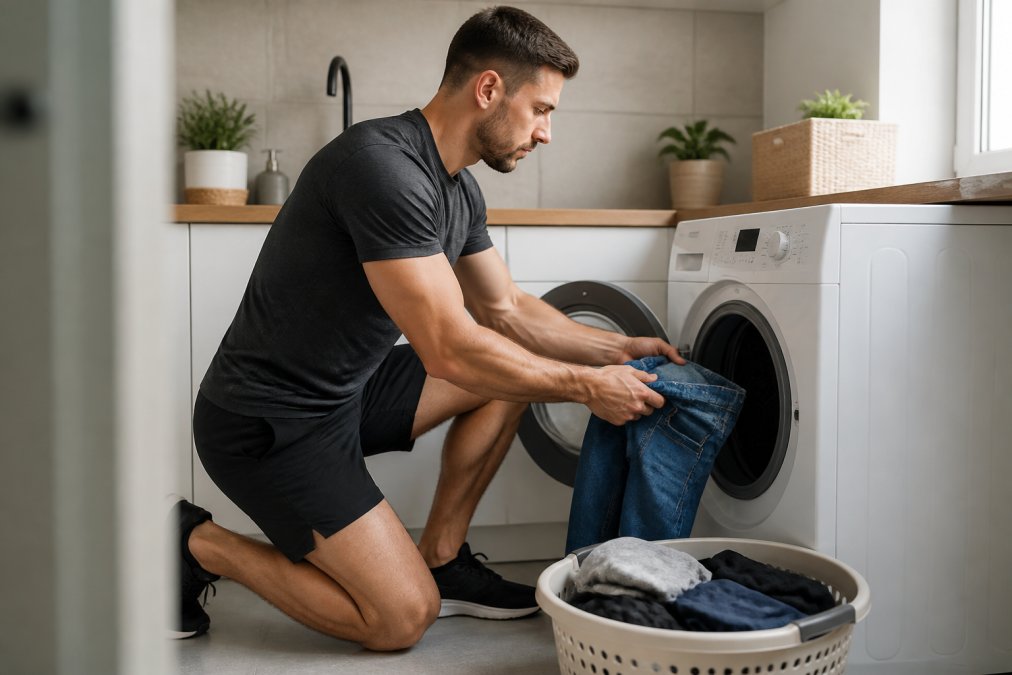
Washing and Laundry Care Instructions That Actually Work
A common mistake is treating stretch denim like ordinary cotton. Elastane is often just 2% to 5% of the blend but does all the recovery work, so anything that attacks it attacks the whole garment.
Temperature. Elastane's hard segments soften well below boiling point, so 30°C is the safe ceiling: it removes sweat and body oils without relaxing the polymer. A 60°C wash will not destroy a garment in one cycle, but repeated hot washes are the most common cause of premature sagging.
Mechanical action. A high-spin cycle drags wet fabric against itself and the drum wall, and wet elastane abrades more easily than dry. Choose the lowest spin your machine offers, usually 400 to 600 rpm, and accept a damper garment as a fair trade for extra wear.
Chemistry. Non-biological detergent is safer because biological formulas contain enzymes that can nibble at fibre finishes. Fabric softener is worse: it deposits a waxy layer that reduces the elastane's ability to snap back, which is why a softener-treated pair feels limp rather than springy. Chlorine bleach is the hardest stop, it attacks the polymer directly and the damage is permanent.
Follow this routine:
- Turn the garment inside out before washing
- Wash at 30°C or cooler on a gentle or hand-wash cycle
- Drop the spin speed to 400-600 rpm
- Use a mild, non-biological detergent
- Skip fabric softener, which coats the fibre and reduces elasticity
- Wash with similar weights to limit abrasion
- Reshape by hand and dry flat or hang in shade
- Never tumble dry, never wring, never bleach
The UK care labelling guidance from the Department for Business and Trade sets out the wash symbols you will find on the label, and those symbols are the minimum standard, not a target to exceed. A label that permits a 40°C wash is telling you the fabric will survive it, not that it will thrive.
Drying and Storage: The Half of Care Nobody Talks About
Most shape loss happens after the wash, not during it. Tumble drying combines three stressors: heat above 40°C, tumbling agitation, and the drum holding the fabric under tension while warm. One hot cycle can leave a garment permanently baggy, and no wash will reverse it.
Air drying is not automatically safe either. Hanging a wet, heavy stretch garment by the shoulders lets gravity pull the fibres while they are most relaxed, causing stretched-out necklines and drooping hems. Dry flat on a rack, or hang by the waistband with the legs supported, and keep it out of direct sunlight, UV degrades elastane just as heat does.
Storage matters more than most people realise. Fold hyper stretch clothing rather than hanging it, because heavy jeans on a hanger stretch the waistband and yoke under their own weight. Fold along the leg and stack rather than cramming into a full drawer, which forces creases that become permanent set points. Make sure everything is bone dry before it goes away; damp fabric stored in a bag breeds fibre relaxation and odour.
Why Fabric Weight Changes Everything
Two garments can carry the same 4% elastane content and behave completely differently, because the base cloth does most of the structural work. Fabric weight, measured in GSM (grams per square metre), is the best predictor of how long a stretch garment will hold its shape.
A light knit in the 180-220 GSM range relies almost entirely on the elastane for recovery, so when the elastane fatigues nothing holds the shape. A mid-weight stretch denim in the 300-400 GSM range has enough yarn density to support the elastane, so the garment keeps its silhouette as the fibre ages. This is why cheap fast-fashion stretch wears out so quickly: thin, light and built to a price, with the elastane doing all the work alone.
When comparing two pairs on the rail, weight is the tell. A heavier fabric feels denser and holds a crease; a light one feels flimsy. The heavier pair will almost always outlast the lighter one, even at the same claimed stretch percentage.
2-Way vs 4-Way Stretch: What the Label Doesn't Tell You
Two-way stretch means the fabric stretches in one direction, usually across the width. Four-way stretch means it stretches both across and along the length. For lifting, squatting and walking, four-way stretch is better because it moves with the leg in every direction.
| Type | Direction of Stretch | Best For | Recovery Under Load |
|---|---|---|---|
| 2-way stretch | Across the width only | Casual tops, light movement | Moderate |
| 4-way stretch | Width and length | Squats, lifting, CrossFit | Higher |
The label rarely states the stretch percentage, which is the number that actually matters.
How to Test Fabric Recovery Before You Buy
The Snap-Back Test
Reading the Label Like a Buyer, Not a Shopper
Repair or Replace? When Stretched-Out Clothing Is Worth Fixing
Can You Shrink Stretch Fabric Back Into Shape?
Repair or Replace? When Stretched-Out Clothing Is Worth Fixing
Storing Hyper Stretch Clothing So It Keeps Its Shape
Conclusion
Frequently Asked Questions
Do hyper stretch fabrics lose their elasticity over time?
Yes, but how quickly depends on fibre content and care. Elastane fibres degrade with repeated heat exposure and mechanical stress, so a pair of hyper stretch jeans washed in cold water and air-dried can hold shape for years, while the same pair tumble-dried weekly may sag within months. Checking the elastane percentage on the label gives you a rough idea of how much stretch recovery the fabric can sustain.
Why does my muscle-fit clothing lose its tailored shape?
Muscle-fit clothing relies on stretch percentage and fabric memory to contour to your body. When elastane breaks down from heat, harsh detergent, or overloading the washing machine, the fabric stops snapping back and starts to bag at the knees, seat, or waist. Switching to a gentle cycle at 30°C and avoiding tumble drying is the single biggest change you can make to preserve that tailored fit.
Does fabric composition affect how quickly clothes stretch out?
It does. Fabrics with a higher elastane or spandex content generally recover better. Blends that include viscose or other natural fibres can relax more easily because those fibres lack the elastic memory of synthetics. A fabric with good dimensional stability will return to its original shape after wearing, whereas a low-elastane knit will stay stretched.
What is the best way to wash high-stretch gym clothing?
Wash at 30°C on a gentle cycle with a low-spin setting, use a mild detergent without bleach or fabric softener, and turn garments inside out to reduce surface friction. Avoid overloading the drum, which puts extra mechanical stress on stretch stitches. Air-dry flat or hang in shade rather than using a tumble dryer, since heat is the main cause of fibre degradation in elastane-rich fabrics.