

Last Updated: October 30, 2026
Quick Summary
A mid-to-high athletic body rise with a tapered or contoured waist is the best choice for athletic builds, since it anchors at your natural waist and clears your glutes and thighs. Athletic builds typically need a rise 2-4 cm higher than a brand's stated regular rise. Check your front rise against your torso length before buying.
- Measure front rise from the crotch seam to the top of the waistband on jeans laid flat.
- If torso length minus front rise exceeds about 5 cm, a standard mid-rise will likely gap at the back.
- Low-rise waistbands slide down on developed glutes and expose the waist gap at the back.
- Fix a waist gap by checking the rise first, then a contoured waistband, back seam, or dart.
- Stretch denim moves with your quads and glutes, while structured denim holds shape with less give.
Table of Contents
- Why Standard Rises Fail Athletic Builds
- How to Measure Jeans Rise and Torso Proportions
- Low-Rise vs Mid-Rise Jeans for Athletic Shapes
- The Best Rise for Jeans for Muscular Thighs
- How to Stop Jeans Gaping at the Waist
- Matching Rise, Cut and Fabric to Your Training
- Try a Muscle-Fit Rise That Moves With You
- Frequently Asked Questions
Why Standard Rises Fail Athletic Builds
Many standard jeans are cut for a narrower frame, which is why the athletic body rise can be tricky to get right. A standard rise assumes a narrow waist, a flat seat and modest thighs. Your body has none of those.
An athletic body type is one where muscle development in the thighs, glutes and seat changes how fabric sits on your frame. When a jean's rise is too short, the waistband lands below your natural waist and cuts across the hips. The result is a waist gap at the back, a tight seat, and a waistband that fights every step.
Here's what most guides get wrong: they tell you to size up. Sizing up fixes the thighs and ruins the waist. You end up with a baggy waistband and a seat that sags. Fitizen builds jeans for athletic bodies, which is one way to approach the problem.
Watch out: a low standard rise on a deep torso will pull down at the back every time you sit. That's not a sizing issue. It's a rise issue.
How to Measure Jeans Rise and Torso Proportions
Rise is the distance from the crotch seam to the top of the waistband. Measuring it takes two minutes and saves you years of bad purchases. But the number alone means nothing without your torso length, the two together tell you whether a rise will actually reach your natural waist.
Here's the method we recommend:
- Lay your best-fitting jeans flat on a table.
- Find the crotch seam where the two legs meet.
- Run a soft tape from that seam straight up to the top edge of the waistband.
- Note the number in centimetres. This is your front rise.
Now measure your torso. Sit on a chair and measure from your natural waist, the crease when you bend sideways, down to the chair seat. Write that down too. A longer torso usually needs a higher rise to reach your natural waist. A shorter torso can carry a mid-rise without the waistband riding up into your ribs.
Here's the comparison that most guides skip: subtract your front rise from your torso length. If the difference is more than about 5 cm, a standard mid-rise will likely sit below your natural waist and gap at the back. If the difference is under 2 cm, a high-rise may feel too restrictive across the stomach. Most athletic builds land in the 3-5 cm range, which is why a mid-to-high rise with a contoured waistband tends to work best.
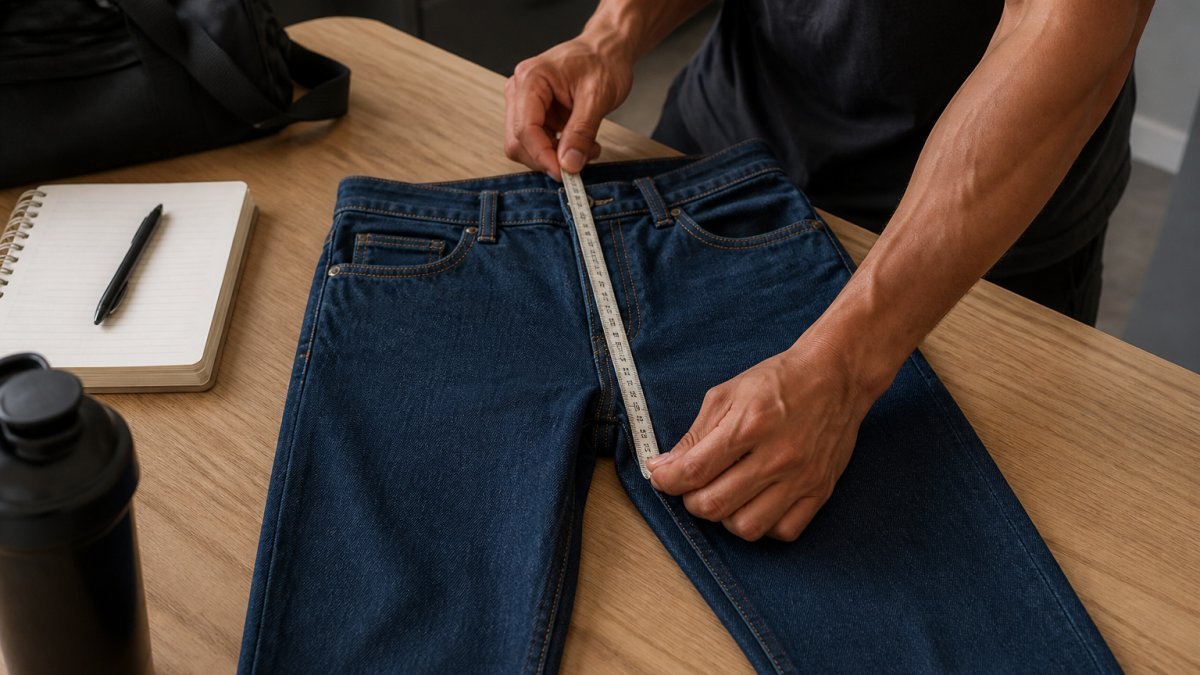
Check the UK government guidance on clothing size labelling if you want to understand how sizing standards work. Most brands don't publish rise measurements, so your own tape is the reliable tool. A common pattern is that athletic builds need a rise 2-4 cm higher than the brand's stated "regular" rise to clear the glutes and reach the natural waist.
Low-Rise vs Mid-Rise Jeans for Athletic Shapes
Low-rise jeans sit below the hips. Mid-rise jeans sit at or just below the navel. For athletic builds, mid-rise wins almost every time, but the reason matters more than the verdict.
Low-rise flatters a short torso and a flat seat. On a lifter with developed glutes, a low-rise waistband tends to slide down when you squat or sit. It also exposes the waist gap at the back. The mechanism is simple: the waistband sits on the widest part of your hips, and every time your glutes engage, they push the fabric down. A belt makes it worse by bunching the fabric and making the seat sag.
Mid-rise gives you more coverage through the seat and holds the waistband closer to your natural waist. That means less gaping and a cleaner silhouette. If you have a long torso, a mid-rise may still sit low on you, so check the measurement before you buy.
| Rise | Where It Sits | Best For | Watch Out For |
|---|---|---|---|
| Low-rise | Below the hips | Short torsos, flat seats | Sliding down, back gap, seat sag |
| Mid-rise | At or below the navel | Most athletic builds | Can sit low on long torsos |
| High-rise | At or above the navel | Long torsos, big glutes | Can feel tight on a deep seat |
If neither low nor mid-rise works, the problem is usually the waistband construction, not the rise height. Look for a contoured waistband that curves in at the back, or a tailored waist that is cut narrower than the hip. These features close the gap without forcing you into a high-rise that feels restrictive.
The Best Rise for Jeans for Muscular Thighs
A mid-to-high athletic body rise with a tapered waist is the best rise for muscular thighs. The higher waistband anchors the jean so the thigh doesn't drag it down.
Thigh room comes from the cut, not the rise alone. Look for a straight or slim fit with stretch through the leg. A structured denim with no give will grip your quads and pull at the seams.
DenimTech Jeans In Medium Wash →
Our athletic fit jeans are cut for muscular builds with a muscle-fit design. If you want to compare specific pairs before committing, our guide to the best jeans for muscular thighs breaks down the options.
The waist-to-hip fit is the number that matters most. When the waist is tailored and the hip has room, the jean follows your shape instead of fighting it.
How to Stop Jeans Gaping at the Waist
A waist gap happens when the waistband is wider than your waist but the seat and thighs fit correctly. It's the classic athletic fit problem.
Try these fixes in order:
- Check the rise first. A higher rise often closes the gap on its own.
- Look for a contoured or tailored waistband that curves in at the back.
- Take in the back seam at a tailor for a permanent fix.
- Add a small dart at the centre back if the gap is minor.
For quick, no-sew options, our guide to DIY fixes for a waist gap walks through each method step by step. A common mistake is cinching a belt to hide the gap. That bunches the fabric and makes the seat sag.
Matching Rise, Cut and Fabric to Your Training
Rise is only one part of the fit. Cut and fabric decide how the jean moves with you.
Cut sets the leg shape. A straight fit balances big thighs and keeps a clean line to the ankle. A slim fit skims the leg but needs stretch to avoid gripping. A bootcut adds room at the leg opening, which balances wide shoulders and a heavy upper body.
Fabric decides mobility. Stretch denim moves with your quads and glutes. Structured denim holds its shape but offers less give. For training days and long days on your feet, stretch wins.
If you train hard and wear your jeans all day, read our breakdown of fit and fabric for athletic builds to match the two properly. The right combination gives you comfort in the gym and a sharp line on the street.
Try a Muscle-Fit Rise That Moves With You
The right rise ends the size-up compromise. When the waistband sits at your natural waist and the leg clears your thigh, you get a fit that shows your shape instead of hiding it.
The Hyper Stretch Jeans in Stay Black are built for athletic bodies, using HYPERstretch denim developed to keep their black tone after multiple wears and washes.

We also offer DenimTech jeans with thermo-regulating, sweat-wicking fabric for year-round wear, plus stretch chinos for days when jeans feel too casual.
Get started with Fitizen and find a rise that fits the body you've built, not the one off-the-rack jeans assume.
Frequently Asked Questions
What jeans rise is best for an athletic body type?
A mid-rise is the safest starting point for most athletic builds. It sits close to the natural waist without cutting into a developed seat, and it leaves room for glutes and quads. If your torso is short, a low-rise can feel more balanced; if you want coverage when bending and lifting, a high-rise works better. Measure your rise and try one pair in each option before committing.
Are mid-rise jeans comfortable for muscular thighs?
Yes, when the denim has enough stretch and the leg is cut with room through the thigh. Mid-rise jeans for muscular thighs work best in hyper-stretch or performance denim rather than rigid cotton. Check the thigh room by sitting and squatting in the fitting room. If the fabric pulls tight across the front of the thigh or the seams strain, size up or choose a straighter leg.
How do you stop jeans from gaping at the back?
A gaping waistband usually means the rise is too low or the waist is cut too straight for your hip-to-waist ratio. Try a higher rise with a contoured or tailored waistband, or take the jeans to a tailor to take in the back seam. A belt helps, but it does not fix the underlying fit. Hyper-stretch denim with a shaped waistband reduces the gap without restricting movement.
Should athletic body types choose stretch jeans?
Stretch denim is usually the better choice for athletic builds because it moves with quads, glutes and thighs instead of fighting them. Look for a high stretch percentage and a recovery claim so the fabric springs back after wear. Structured denim can work for a sharper silhouette, but it needs a generous cut through the seat and thigh. Test by squatting and walking before you buy.
