

Table of Contents
- What Makes Muscle Fit Clothes Expensive
- Muscle Fit vs Slim Fit Comparison
- Benefits of Hyper-Stretch Fabric
- Best Athletic Fit Clothing Brands
- Cost-Per-Wear: The Real Test
- Are Expensive Muscle Fit Clothes Worth It?
- Common Mistakes When Buying Muscle Fit Clothes
- Frequently Asked Questions
Last Updated: September 12, 2026
What Makes Muscle Fit Clothes Expensive
Muscle fit clothes cost more because they are engineered around a body shape, not just cut smaller. The price reflects fabric technology, pattern grading across multiple muscle groups, and lower production volumes than standard high-street sizing.
At Fitizen, we build every garment for lifters first: hyper-stretch fabrics and muscle fit design. That approach costs more to produce than a basic cotton tee.
Here's the part most shoppers miss. You are not paying for a logo. You are paying for Textile Exchange's materials market reporting grade fibres, four-way stretch, and shape retention that survives repeated washing.
Cheap stretch garments typically use elastane blended at low percentages. They feel fine in the changing room and sag by week six.
| Cost Driver | Budget Garment | Premium Muscle Fit |
|---|---|---|
| Fabric | Basic cotton, low elastane | Gracell, bamboo, high-tenacity stretch |
| Pattern grading | One block, scaled up | Graded per muscle group |
| Seam construction | Standard overlock | Reinforced, stretch-matched seams |
| Shape retention | Loses fit after washes | Holds silhouette |
| Production volume | Mass market | Limited runs |
Muscle Fit vs Slim Fit Comparison
Slim fit tapers through the body but assumes a narrow chest and flat shoulders. Muscle fit is cut for a wider chest, larger arms, and a defined shoulder-to-waist ratio, so it contours instead of clinging. The difference is not marketing language, it is pattern grading, and it shows up in centimetres.
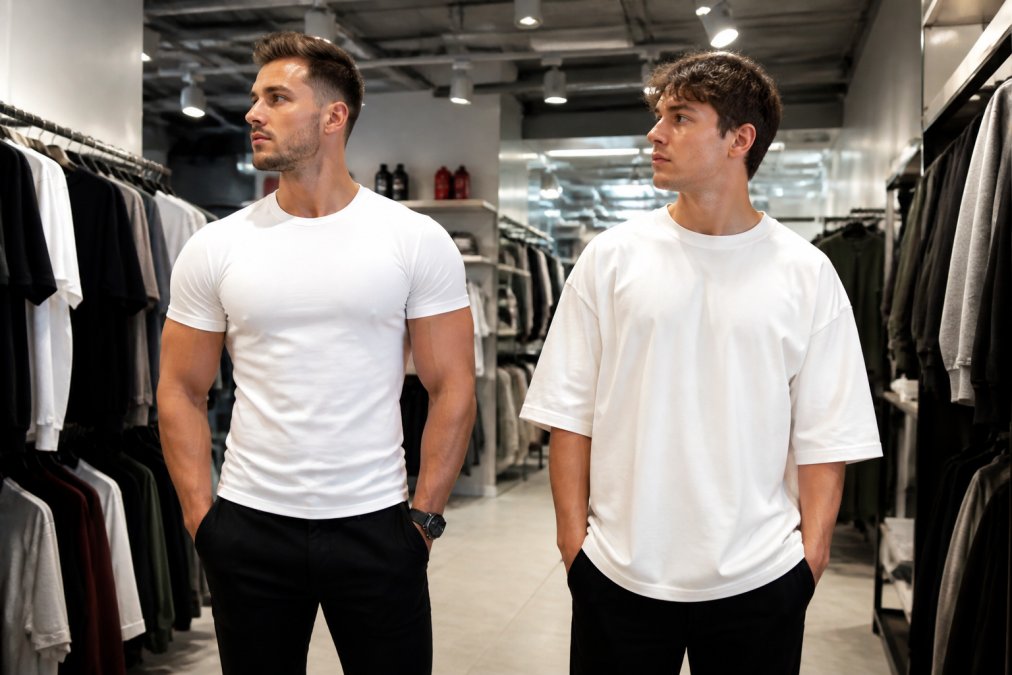
A typical slim-fit medium might measure 96 cm across the chest and 86 cm at the waist (gov.uk). A muscle-fit medium from a brand that grades for athletes often runs 104 cm chest and 84 cm waist, more room where you have built mass, less where you have not. That 8 cm chest delta and 2 cm waist reduction is the entire point of the cut.
The practical difference shows up in four places:
- Armhole placement. Slim fit armholes sit low and restrict pressing and overhead movement. Muscle fit raises them, usually by 2-3 cm, so the sleeve follows the deltoid rather than cutting into the armpit.
- Chest circumference. Slim fit adds room at the waist. Muscle fit adds it at the chest and shoulders, then tapers back through the midsection.
- Waist suppression. Slim fit pulls. Muscle fit follows the taper you already built, often with a slight curve at the lumbar rather than a straight side seam.
- Sleeve length and bicep allowance. Muscle fit shortens the sleeve slightly and widens the bicep opening so the hem does not ride up when you raise your arms.
If you have ever sized up to fit your quads and ended up with a billowing waist, you have hit the exact problem muscle fit solves. The trade-off is that muscle fit is less forgiving if your measurements sit between two sizes, you may need to choose between a snug chest and a relaxed waist, which is why brands that publish chest, shoulder, and waist measurements separately are easier to buy from than those that only list S/M/L.
One more distinction worth knowing: "athletic fit" is often used interchangeably with muscle fit, but some brands use it to mean a slightly roomier slim fit with a bit more shoulder room. Always check the actual chest and waist measurements rather than trusting the label.
Benefits of Hyper-Stretch Fabric
Hyper-stretch fabric delivers the comfort of gymwear in a garment that still looks tailored. The benefit is mechanical: four-way stretch moves with the muscle instead of resisting it, and the fabric returns to shape rather than sagging at the stress points.
For anyone squatting, walking, or sitting through a full working day, that matters more than the label. A British Standards Institution guide to textile testing approach to fabric testing covers stretch recovery and shrinkage resistance, the two properties that decide whether a garment keeps its shape.
What most guides miss is that stretch percentage is only half the story. Recovery is the other half. A fabric that stretches to 40% but recovers poorly will bag at the knees and elbows within a month. Look for garments that state both the stretch percentage and the recovery rating, or that use high-tenacity fibres rather than relying on elastane alone.
Gracell fibre, made from wood pulp, combines silky softness with high tenacity. Bamboo adds breathability and moisture-wicking. Both hold their shape far better than a low-grade elastane blend. The practical difference is that a Gracell or bamboo-blend tee can accommodate fluctuating measurements, chest, arms, and waist, so the same shirt works across a training cycle.
Muscle fit clothing is not just for the physique you have today. If you are bulking through winter and cutting for summer, a garment that only fits at one weight is a garment you replace twice a year. Four-way stretch with good recovery accommodates fluctuating measurements, chest, arms, and waist, so the same shirt works across a training cycle.
Here is what to check on the label or product page:
- Stretch direction. Two-way stretch moves in one direction; four-way moves in both. Four-way is what you want for lifting and overhead movement.
- Fibre composition. High-tenacity fibres (Gracell, bamboo, some recycled poly blends) outperform basic cotton with a low elastane percentage.
- Recovery language. "Shape retention" or "recovery" claims are more useful than "stretch" alone.
- Weight and breathability. Heavier fabrics drape better but trap heat; lighter fabrics breathe but can cling. A mid-weight blend is the usual compromise.
The cost-per-wear maths follows directly from this. A £39 tee that holds its shape for two years of twice-weekly wear costs about 38p per wear. A £12 tee that sags after ten washes and gets retired costs more, because you buy it three or four times over the same period. Fabric technology is not a luxury feature, it is the variable that decides which side of that equation you land on.
Best Athletic Fit Clothing Brands
The best athletic fit clothing brands are the ones that grade patterns for muscular proportions rather than scaling up a standard block. Fit accuracy, fabric composition, and seam construction separate the genuinely athletic cuts from marketing.
Fitizen is our top pick for lifters and bodybuilders. Every piece is designed to highlight your physique, from the High Performance Shirt in Pure White (£51.75) with its Gracell fibre, to the Bamboo Tee in Sky Blue (£39.00) that regulates temperature and wicks moisture.

| Product | Price | Fabric | Best For |
|---|---|---|---|
| High Performance Shirt In Pure White | £51.75 | Gracell | Smart-casual, office |
| High Performance Shirt In Jet Black | £69.00 | Gracell | Evening, layering |
| Bamboo Tee In Sky Blue | £39.00 | Bamboo | Warm weather, gym-to-street |
| Tee In Jet Black | £39.00 | Muscle-hugging stretch | Everyday staple |
| Muscle Fit Polo In Navy Blue | £49.00 | Hyper-stretch | Smart-casual, versatile |
When you compare providers, ask three questions: does the brand publish a size guide, does it state fabric composition, and does it show real customers with an athletic build?
Cost-Per-Wear: The Real Test
Cost-per-wear is the price of a garment divided by the number of times you actually wear it. A £39 tee worn twice a week for two years costs about 38p per wear. A £12 tee that sags after ten washes and gets retired costs more.
This is the calculation fast-fashion pricing hides. Cheap garments fail early, so you replace them repeatedly, and the total spend climbs.
Run the numbers on your own wardrobe:
- Note the price you paid
- Estimate wears before the fit degrades
- Divide price by wears
- Compare against a premium alternative worn for longer
A garment that keeps its shape for two years beats three cheap replacements every time. Durability is not a luxury feature. It is the whole equation.
Are Expensive Muscle Fit Clothes Worth It?
Yes, for anyone whose physique does not fit standard sizing. Expensive muscle fit clothes are worth it when the alternative is a wardrobe of ill-fitting garments you avoid wearing.
The value case rests on three things: fit accuracy for a muscular build, fabric that retains shape, and a cost-per-wear that undercuts repeated cheap replacements.
If you are a bodybuilder, CrossFit athlete, or lifter with large quads and shoulders, off-the-rack standard sizing rarely works. Bespoke tailoring solves it but costs far more per garment.
Premium muscle fit pays off when you wear the garment often and it holds its fit. If you wear it twice a year, buy cheaper. If it is a wardrobe staple, the cost-per-wear maths favours quality every time. ::: Extending this logic to your gym rotation helps clarify the premium activewear value inherent in fabrics engineered to retain their shape through repeated high-intensity cycles.
Common Mistakes When Buying Muscle Fit Clothes
The biggest mistake is buying for the size you want rather than the body you have. Muscle fit relies on accurate body measurements, so start with a tape measure, not a size label.
Other common errors:
- Ignoring the size guide. Chest circumference and waist suppression vary between brands. Always check the specific chart.
- Confusing tight with fitted. A garment that restricts movement is too small, not "muscle fit".
- Skipping fabric composition. Check the stretch percentage and recovery rating before you buy.
- Overlooking seam construction. Flatlock and stretch-matched seams survive training. Standard overlock does not.
- Buying one piece instead of a rotation. Wardrobe staples work as a system: tees, polos, and shirts that layer together.
Here is how to tell "too tight" from "muscle fit" at a glance. Too tight pulls across the chest, rides up at the hem, and restricts overhead reach. Muscle fit contours the chest and shoulders, sits flat at the hem, and lets you move freely.
If you are coming from fast fashion, expect the first premium piece to feel different. It should.
Finding clothes that fit a muscular build without drowning your waist in excess fabric is a genuine challenge, and most high-street sizing was never designed for it. Fitizen solves that with muscle fit design built for athletes, hyper-stretch fabrics that move through squats and walking, and a fit that highlights your physique instead of hiding it. With a 4.8/5 average rating and over 40,000 products sold, the proof sits with lifters worldwide. View the Fitizen collection and find the fit your training deserves.
Frequently Asked Questions
What is the difference between muscle fit and slim fit?
Muscle fit clothing is cut to accommodate broader shoulders, a wider chest, and larger arms while tapering at the waist to create a V-taper silhouette. Slim fit narrows throughout the body without extra room for muscle groups. If you have an athletic build, muscle fit avoids the tightness across the chest and shoulders that slim fit creates, while still delivering a tailored look rather than a baggy one.
Do expensive muscle fit clothes last longer?
They often do, but it depends on the fabric and construction. Cheaper stretch garments typically use elastane blends that lose shape after repeated washing. Higher-priced options use fibres like Gracell or bamboo with better shape retention and shrinkage resistance. The seams and armhole placement also matter. Look for reinforced seam construction and fabric composition details before assuming price equals longevity.
How should muscle fit clothing feel on an athletic build?
It should feel snug across the chest and shoulders without restricting movement, with enough room through the arms and thighs for full range of motion. The waist should taper without pinching. If you cannot raise your arms overhead or squat comfortably, the fit is too tight. If the fabric hangs loose at the waist, it is too baggy. A proper muscle fit contours to your proportions while letting you move freely.
Are hyper-stretch fabrics worth the extra cost?
Hyper-stretch fabrics cost more because they offer 4-way stretch, moisture-wicking, and breathability that basic cotton cannot match. For athletes who need clothing that works from the gym to the office, the added stretch and shape retention reduce the need to buy replacements every few months. If you wear your clothes frequently and want them to maintain their fit after washing, the higher upfront cost often pays off over time.