

Table of Contents
- Why Off-the-Rack Shirts Look Baggy on Athletic Builds
- Shoulder Seam, Torso Volume and the Sizing Myth
- How to Fix Baggy T-Shirt Sleeves
- How to Tuck in a Shirt Properly
- The Benefits of Muscle Fit Clothing for Lifters and Athletes
- Tailoring and Fabric Fixes That Stop Shirts Looking Baggy
- Common Mistakes That Keep Shirts Looking Baggy
- Conclusion
- Frequently Asked Questions
Last Updated: September 23, 2026
Why Off-the-Rack Shirts Look Baggy on Athletic Builds
If you have spent years building your shoulders, chest and back, you already know how to stop shirts looking baggy is the frustration. You buy a shirt that fits your neck, and the body hangs off you like a tent. You size down, and the shoulders pull tight while the waist still billows. Learning how to stop shirts looking baggy is mostly about understanding one thing: standard sizing was never built for your frame.
Most high-street shirts are cut for an average build with a straight torso. When you add muscle, the ratio between your shoulders and your waist stops matching that pattern. The result is excess fabric everywhere the shirt was never designed to taper. At Fitizen, we see this problem every day from lifters, CrossFit athletes and bodybuilders who are tired of choosing between a shirt that strangles their arms and one that hides their physique.
The good news is that you do not need a bespoke tailor to fix it. A few styling methods, the right fabric and small alterations will do most of the work.
Shoulder Seam, Torso Volume and the Sizing Myth
The shoulder seam is the single most important fit point on any shirt. It should sit right at the edge of your shoulder bone, not hang past it. If the seam droops down your arm, the shirt is too big, and no amount of tucking will save it.
Here is the sizing myth most guides repeat: "size up for the shoulders and tailor the rest." That advice fails for muscular builds.
Check these three points before you buy anything:
- Shoulder seam: sits on the shoulder edge, not past it
- Armhole: high and snug, so your lats and chest fill the shirt
- Torso: follows your waist instead of hanging straight down
How to Fix Baggy T-Shirt Sleeves
Baggy t-shirt sleeves are the fastest giveaway that a shirt does not fit. The fix depends on how much extra fabric you have.
How to Tuck in a Shirt Properly
A proper tuck controls torso volume and defines your waist. The goal is a clean line from chest to waist, with no bunched fabric at the sides and no ballooning at the back.
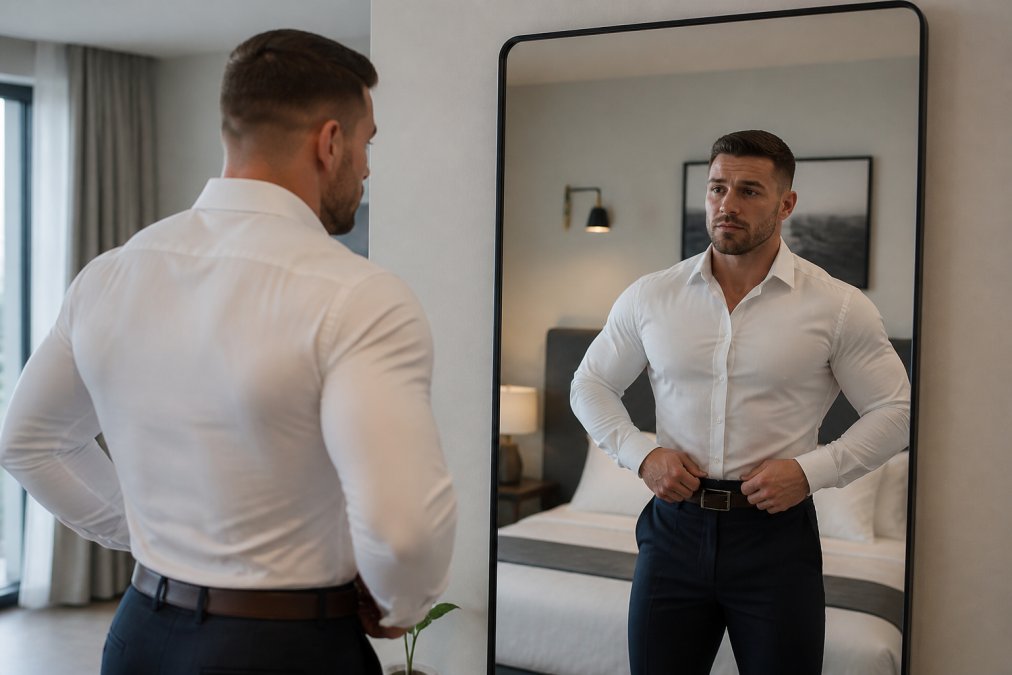
Work through it in this order:
- Do up all the buttons, including the collar, so the shirt sits on your frame the way it will when worn.
- Push the shirt down and slightly back so the front panel sits flat against your stomach. Do not pull it forward, that is what creates the bulge.
- Gather the excess fabric to the sides. All the spare volume should end up at your left and right hips, not at the front or back.
- Fold the side fabric backward, not forward. Folding it back tucks the excess behind the front panel and keeps the front smooth.
- Fasten your belt over the folded fabric to lock it in place, then smooth the front with your hands.
The Military Tuck and the French Tuck
The military tuck is the tighter of the two. You fold the excess fabric at each side seam into a neat vertical pleat, then pin or hold it as you fasten your belt. It gives a sharp, structured look and works well for formal shirts. The trade-off is that it can feel restrictive across the stomach when you sit down, and the pleats can work loose over a long day.
Matching the Tuck to Your Body Shape
Why a shirt looks baggy depends heavily on your proportions, and the right tuck changes with them:
High Performance Shirt In Pure White →
- Broad shoulders, narrow waist (the classic athletic V): the military tuck is essential. Without it, the fabric that fits your shoulders has nowhere to go at the waist and billows. Back darts plus a military tuck is the strongest combination.
- Straight torso with little waist definition: a French tuck often looks better, because a tight military tuck on a straight frame can create an unnatural pinch. Let the shirt fall naturally at the back.
- Longer torso: tuck deeper and consider having the shirt hem shortened, otherwise the fabric has too far to travel and will work loose.
- Shorter torso: avoid over-tucking. A shallow military tuck keeps the proportions balanced.
The Benefits of Muscle Fit Clothing for Lifters and Athletes
Muscle fit clothing solves the baggy shirt problem at the source instead of patching it afterward. Instead of cutting for an average frame and hoping you can tailor it down, muscle fit is drafted for wider shoulders, a fuller chest and a narrower waist.
The main benefits for athletes:
- Less excess fabric through the torso, so no billowing at the waist
- A higher armhole that fits around bigger lats and arms
- Stretch fabrics that move with you instead of pulling tight
- A defined silhouette that shows the work you have put in
Tailoring and Fabric Fixes That Stop Shirts Looking Baggy
Fabric choice matters as much as the cut, and it is the part most guides skip. Two shirts can carry the same measurements on the label and still hang completely differently on your frame, because bagginess is a product of how the cloth behaves, not just how it is cut.
- Lightweight (roughly 120-150 GSM): thin poplin, voile and most stretch blends. These cling and show every contour, which flatters a lean frame but can highlight softness around the waist.
- Midweight (roughly 150-200 GSM): the sweet spot for most shirts. Enough body to hold a clean line, enough give to move with you.
- Heavyweight (roughly 200 GSM and up): oxford cloth, heavy twill and brushed cotton. These hold their shape and drape cleanly, but they have little stretch, so a poor cut shows up sharply.
What a Tailor Can Actually Do
If a shirt is close but not perfect, a tailor has four levers. Ask for them by name:
- Take in the side seams to reduce torso volume. This is the standard fix for a shirt that fits the shoulders but billows at the waist.
- Add darts at the back for waist definition. Two vertical darts run from the shoulder blades down to the waist, pulling the fabric in without touching the front.
- Taper the sleeves from the armhole down to the cuff so they follow your arm instead of hanging.
- Shorten the sleeve length so the cuff hits your wrist bone.
Laundry, Shrinkage and Holding the Fit
Laundry is where many good shirts quietly fall apart. Cotton shrinks because the fibres relax and contract when they are heated and agitated, and the fit you loved in the shop can change after two washes.
- Wash in cold water on a gentle cycle. Cold water limits fibre contraction and protects colour.
- Skip the tumble dryer. Hang to dry, ideally on a shaped hanger so the shoulders keep their line.
- Stretch the shirt gently back into shape while damp. This is the moment you can correct minor distortion before the fibres set.
- Turn shirts inside out to protect the finish and reduce surface abrasion.
Common Mistakes That Keep Shirts Looking Baggy
The biggest mistake is sizing up to fix the shoulders. This adds torso volume you cannot remove and drops the armhole, which makes your arms look smaller.
Other common errors:
- Ignoring the shoulder seam and buying on chest size alone
- Cutting sleeves by hand instead of tapering them
- Tucking fabric forward at the front instead of folding it back
- Using a hot dryer and shrinking a shirt out of shape
- Buying a relaxed fit when a slim or muscle fit suits your frame
Conclusion
Baggy shirts on a muscular frame are a fit problem, not a body problem. Fix the shoulder seam, tuck with intent, taper the sleeves and choose fabric with real stretch. That combination removes the excess volume that standard sizing forces on you.
Frequently Asked Questions
How can I make a shirt look less baggy without sewing?
The fastest fix is a proper tuck, not a size change. Try the military tuck: fold the excess fabric at each side seam backwards, then tuck it flat against your waist before fastening your belt. This pulls the extra fabric tight to your torso and removes the boxy look in seconds. A French tuck, where you only tuck the front, works well for casual shirts. If the shirt still billows after tucking, the issue is the cut, and a muscle fit shirt will solve it better than any styling trick.
Why do off-the-rack shirts often look baggy on athletic builds?
High-street shirts are cut for average proportions, so they add fabric around the waist to fit a wider range of people. If you have a broad chest, large shoulders or a narrow waist from training, that extra fabric has nowhere to go and hangs loose. Sizing down fixes the torso but pulls at the shoulder seam and armhole, which restricts movement. This mismatch between chest, waist and sleeve length is exactly why baggy shirts are so common on lifters.
What is the difference between a slim fit and a muscle fit shirt?
Slim fit narrows the waist but keeps a standard chest and shoulder block, so it can still pull across the back on a muscular frame. Muscle fit clothing is cut with extra room through the chest, shoulders and arms, then tapered at the waist to remove torso volume. The result is a defined silhouette that moves with you rather than clinging or hanging. For anyone with a V-taper from lifting, muscle fit gives a cleaner drape than slim fit without restricting your range of movement.
Can a tailor fix a shirt that is too baggy in the waist?
Yes. A tailor can take in the side seams to remove excess torso volume, add darts at the back for waist definition, and taper the sleeves so the cuff fit is snug. Expect to pay roughly £15 to £25 for taking in a shirt waist, and £10 to £20 for sleeve tapering, depending on the tailor and fabric. The catch is that tailoring a cheap shirt costs more than the shirt itself, so it only makes sense on good quality garments you already own.