

Last Updated: October 27, 2026
Quick Summary
Choose blazer sizes for broad shoulders by matching the shoulders first, not the chest. Measure your shoulder width across the back, then compare it with the garment shoulder measurement on the size chart, allowing about 1-2 cm of ease.
- Measure shoulder width from the outer edge of one shoulder bone to the other.
- Compare your shoulder width with the garment's flat shoulder measurement, not the body measurement.
- Allow roughly 1-2 cm of ease over body shoulder width for a structured cut.
- If shoulder and chest sizes disagree, choose the size that fits the shoulders.
- A tailor usually cannot fix shoulder width, so buy for the shoulders and chest.
Table of Contents
- Why Broad Shoulders Make Blazer Sizing Harder
- How to Measure Your Shoulders for a Blazer
- Reading a Blazer Size Chart Against Your Measurements
- Checking Fit While You Wear the Blazer
- Best Blazer Styles for Muscular Men
- Blazer Alterations for Broad Shoulders: What a Tailor Can and Cannot Fix
- Booking Your Next Blazer With Confidence
- Frequently Asked Questions
Why Broad Shoulders Make Blazer Sizing Harder
Fitizen specialises in muscle-fit clothing for athletes, lifters and bodybuilders.
A blazer has to do two jobs at once. It must close comfortably over the chest and it must let the shoulders move without tightening. For a lean frame, both measurements usually fall in the same size band.
Most people solve this by sizing up, which creates a new problem. The body of the jacket hangs loose, the waist looks shapeless and the sleeves grow too long. Get the shoulder fit right first, then work out the rest.
- Chest size alone does not describe shoulder width
- Shoulder seams should sit at the edge of the shoulder bone
- Sizing up for shoulders often leaves the rest of the jacket too big
How to Measure Your Shoulders for a Blazer
Measure your shoulders before you look at any size chart.
Shoulder width: Stand tall with your arms relaxed. Measure from the outer edge of one shoulder bone to the outer edge of the other, across the back.
Chest: Measure around the fullest part of your chest, under the arms, with the tape level across your back.
Sleeve length: Bend your elbow slightly, then measure from the centre of the back of your neck, over the shoulder and down to your wrist bone.
Blazer length: Measure from the base of your neck at the back down to where you want the hem to finish.
Write each number down in centimetres or inches, whichever your size chart uses.
Reading a Blazer Size Chart Against Your Measurements
Size charts list garment measurements, which are the flat dimensions of the jacket itself, not the body measurements you took. The two are different, and confusing them is the single most common reason broad-shouldered buyers order the wrong size.
A garment's shoulder width is measured across the back of the jacket, from one shoulder seam to the other, with the jacket laid flat and buttoned. That figure is a straight-line distance across the outside of the garment. Your body shoulder width is also a straight-line distance, but across bone, not fabric.
How much ease to allow at the shoulder
Ease is the difference between the garment measurement and your body measurement. At the shoulder, most tailored jackets are cut with roughly 1-2 cm of ease over the body measurement, and structured shoulders with padding can sit closer to 2 cm. A jacket whose shoulder measurement matches your body measurement exactly will usually feel tight and pull when you reach forward. A jacket more than about 3 cm wider than your body measurement will tend to drop off the shoulder line and look oversized.
Use this as a shortlist rule, not a guarantee:
- Garment shoulder within about 1-2 cm of your body shoulder width: likely correct for a structured cut
- Garment shoulder equal to your body width: likely too narrow once you move
- Garment shoulder 3 cm or more above your body width: likely to sit past the shoulder bone
Choosing between two sizes
When your shoulder measurement points to one size and your chest points to another, the shoulders win. Buy the size that fits the shoulders, then check whether the chest still allows you to button the jacket without the fabric pulling into an X. If the chest is too tight in the shoulder-correct size, the cut is wrong for you, not the size. Moving up a size to gain chest room adds shoulder width you cannot tailor away.
What to do when the chart is incomplete
Many brands publish chest, waist and sleeve but omit shoulder width. Look for a line labelled "shoulder", "across shoulder" or "across back" in the garment measurements. If none is given, ask the retailer's support team for the flat shoulder measurement of the specific size before you buy; a reputable retailer should be able to supply it. Where only body measurements are listed, treat them as a guide to the brand's intended fit rather than a garment dimension, and expect the jacket to measure wider than the body figure quoted.
Finally, remember that a flat garment measurement is not the same as what you will feel when you wear it. Fabric weight, shoulder padding and cut all change how the jacket sits. Treat the chart as a shortlist, then confirm the fit in person or against a returns policy that lets you try more than one size.
The table below sets out the shoulder-ease rules covered in this section, so you can compare your own measurements against a size chart quickly.
| Garment shoulder vs body shoulder | Likely result | Note |
|---|---|---|
| Within about 1-2 cm wider | Likely correct for a structured cut | Shortlist rule, not a guarantee |
| Equal to body width | Likely too narrow once you move | Pulls and restricts reaching |
| 3 cm or more wider | Likely sits past the shoulder bone | Looks oversized and drops off the shoulder |
Checking Fit While You Wear the Blazer
Once you have a blazer on, check the fit in a fixed order. Start with the shoulders, because a shoulder problem is hard to fix with any tailoring. Work through the checks below and note what you see and feel, not just whether the jacket "seems to fit".
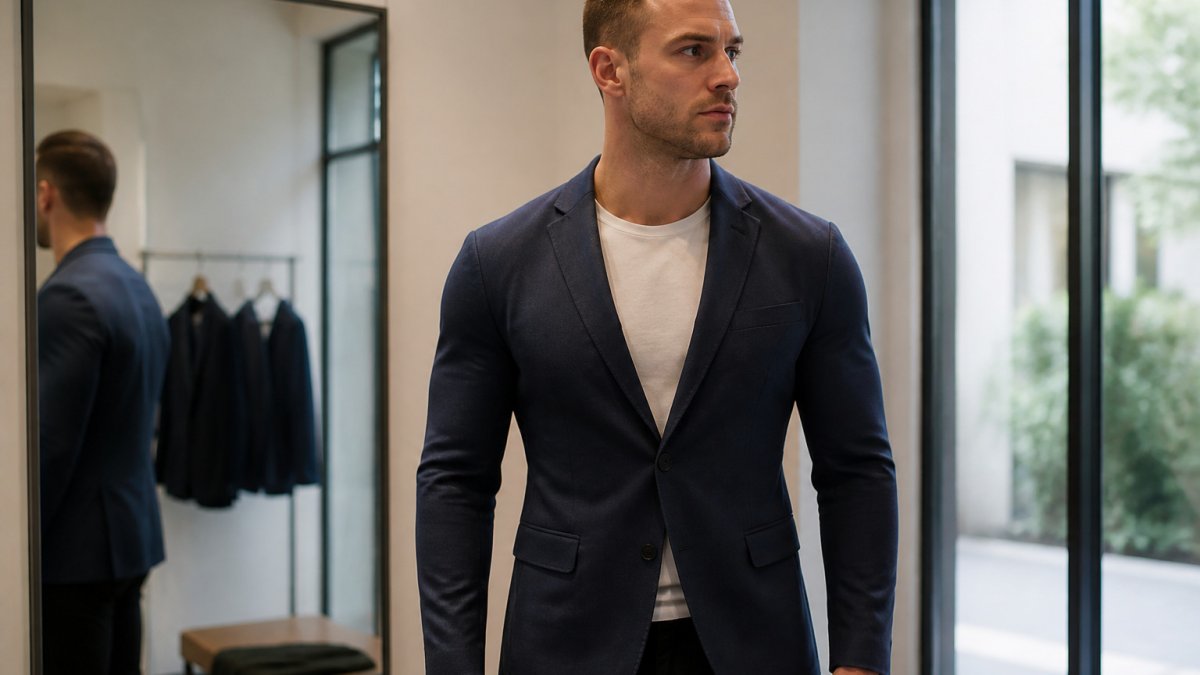
Shoulder seam placement
The shoulder seam should land at the edge of your shoulder bone, where the shoulder turns down into the arm. Stand side-on to a mirror and look for the seam's position relative to the bony point of the shoulder. If the seam sits up on the arm, the jacket is too narrow in the shoulder. If it hangs past the bone and the sleeve head droops, the jacket is too wide.
Signs a shoulder is too narrow
A shoulder that is genuinely too small shows several signs at once:
- Pulling across the upper back: horizontal creases or tension lines radiate from the shoulder blades toward the armholes when you stand normally.
- Dimpling at the sleeve head: the fabric puckers or dents where the sleeve meets the shoulder, because the sleeve is being stretched over a shoulder it was not cut for.
- Restricted arm movement: raising your arms forward or overhead lifts the whole jacket and pulls the hem up your back.
- Seam sitting on the arm: the shoulder seam rests on the upper arm rather than at the bone.
- Collar gap: the collar lifts away from the back of your neck when you move your arms.
If you see two or more of these, the size is wrong regardless of how sharp the cut looks.
Signs a shoulder is intentionally structured
Structured tailoring uses padding and firm canvas along the shoulder to create a clean, defined line. Read styling resort collars for athletic builds for outfit formulas that flatter muscular physiques. That is a design choice, not a fit fault. A structured shoulder that fits correctly still shows:
- The seam at the bone, not up the arm
- Smooth fabric across the upper back with no tension creases
- Padding that follows your natural shoulder slope rather than sitting above it
- Freedom to raise your arms without the jacket riding up your back
The difference is movement. A structured shoulder looks firm standing still but stays comfortable when you move; a too-narrow shoulder looks tight standing still and gets worse when you move.
Chest, sleeves and waist
- Chest: Button the jacket. You should be able to do it without the fabric pulling into an X shape, and the lapels should lie flat against your chest rather than bowing outward.
- Sleeves: Raise your arms as if reaching for a bar. The jacket should lift without riding up your back, and the sleeve should not twist around your arm.
- Sleeve length: The cuff should stop around the wrist bone, showing a small amount of shirt cuff, roughly 1-1.5 cm is a common target.
- Waist and sides: The jacket should taper gently. Loose sides usually mean the chest is right but the cut is not; tight sides that pull at the button mean the chest is too small.
Move before you decide
Do a few movements before you commit. Squat, reach forward, turn your torso and raise your arms overhead. A blazer that feels fine standing can fail the moment you move, and the shoulder is usually where it fails first. If the jacket passes the shoulder checks standing still but pulls or rides up when you move, size up in the shoulder or choose a cut with more room through the sleeve head.
Best Blazer Styles for Muscular Men
Some cuts suit broad shoulders better than others. Look for these features:
- Structured shoulders: Moderate padding gives a clean line without adding bulk.
- Two-button or three-button fronts: These tend to close more cleanly over a larger chest than a single-button front.
- Tapered sides: A slim fit or tailored cut can work well if the shoulders and chest fit. Avoid it if it pulls at the waist.
- Stretch fabrics: A small amount of stretch gives the arms and back room to move without loosening the whole jacket.
Avoid oversized styles, which hide the shoulder line and make the frame look shapeless. The goal is a jacket that follows your build, not one that tries to disguise it.
Blazer Alterations for Broad Shoulders: What a Tailor Can and Cannot Fix
A tailor can change a lot, but not everything. Know the limits before you pay for work.
What a tailor can usually fix:
- Taking in or letting out the body at the sides
- Shortening or lengthening sleeves
- Adjusting the length of the jacket
- Tapering the waist
What a tailor usually cannot fix:
- Shoulder width. Moving a shoulder seam is a major job, and it often means rebuilding the jacket.
- A chest that is too small. Letting out the chest is limited by the seam allowance the maker left.
The practical rule is simple. Buy for the shoulders and chest, then have the sides and sleeves tailored. A jacket that is too small across the shoulders is rarely worth altering, so do not buy one and hope a tailor can save it.
Booking Your Next Blazer With Confidence
Measure your shoulder width, compare it with the garment measurements, check the fit in the order above and only then think about the rest. That sequence will prevent most sizing mistakes for a broad-shouldered build.
If you are not sure which size to order, check our range of muscle-fit clothing for athletes and lifters.
Frequently Asked Questions
Should you size up in a blazer if you have broad shoulders?
Not always. Check the shoulder seam and how the blazer feels across the chest and back. A tailor may be able to adjust parts of the jacket, but the options depend on the garment.
How can you tell if a blazer is too tight across the shoulders?
Look for horizontal creases across the upper back, a shoulder seam that sits inside your shoulder bone, or fabric that pulls toward the armhole when you raise your arms. Notice whether the jacket rides up or the seams strain as you move. These signs can help you assess the fit.
Can a tailor alter a blazer that is tight in the shoulders?
A tailor may be able to adjust some parts of a blazer, but what can be changed depends on the garment. Ask a tailor to assess it before deciding whether alterations are suitable.
Get the shoulders right first and the rest of the blazer follows. If you have a measurement that falls between sizes, take the larger shoulder size and have the sides tailored.
