

Quick Summary
Shirt pulling shoulders usually means the fabric cannot stretch far enough to cover your shoulder width. Measure your shoulders, compare them with the brand's size chart, and choose a muscle fit or athletic cut rather than simply sizing up. Test arm movement before buying.
- Measure shoulder width with a soft tape from bony point to bony point across the upper back.
- Compare the shoulder measurement with the brand's size chart, not just the chest measurement.
- Sizing up often fixes the shoulders but leaves the waist baggy.
- For broad shoulders, a muscle fit or athletic cut gives room where you need it.
- Raise both arms out to the side and overhead to test the fit before you buy.
Table of Contents
- Why Your Shirt Pulls Across the Shoulders
- How to Measure Shoulder Width for a Shirt
- Check the Fit: Where the Shirt Should Sit
- How to Stretch a Tight Shirt Safely
- When Sizing Up Is the Wrong Fix
- Best Shirts for Broad Shoulders
- Choosing a Shirt That Fits Your Shoulders From Day One
- Frequently Asked Questions
Why Your Shirt Pulls Across the Shoulders
Shirt pulling shoulders happens when the fabric has to stretch further than it can comfortably go. A shirt's shoulder seam sits at a fixed point, so when your deltoids and upper back are broad, the fabric has to cover that extra width.
Several things usually cause the tightness:
- Shoulder width is bigger than the cut allows. Standard shirts are built for average frames.
- Fabric has no give. Stiff cotton or woven blends do not stretch when you raise your arms.
- The size is chosen by chest only. Many men buy by chest size and ignore the shoulders.
- Sleeves are set too narrow. A tight armhole pulls the seam towards your back.
A common mistake is assuming the answer is always a bigger size. That fixes the pulling but often creates a baggy waist. The better fix depends on where the tightness sits, so check that first.
How to Measure Shoulder Width for a Shirt
Measuring your shoulders gives you a number to compare with the size chart. Do this with a soft tape measure and a second person if you can.
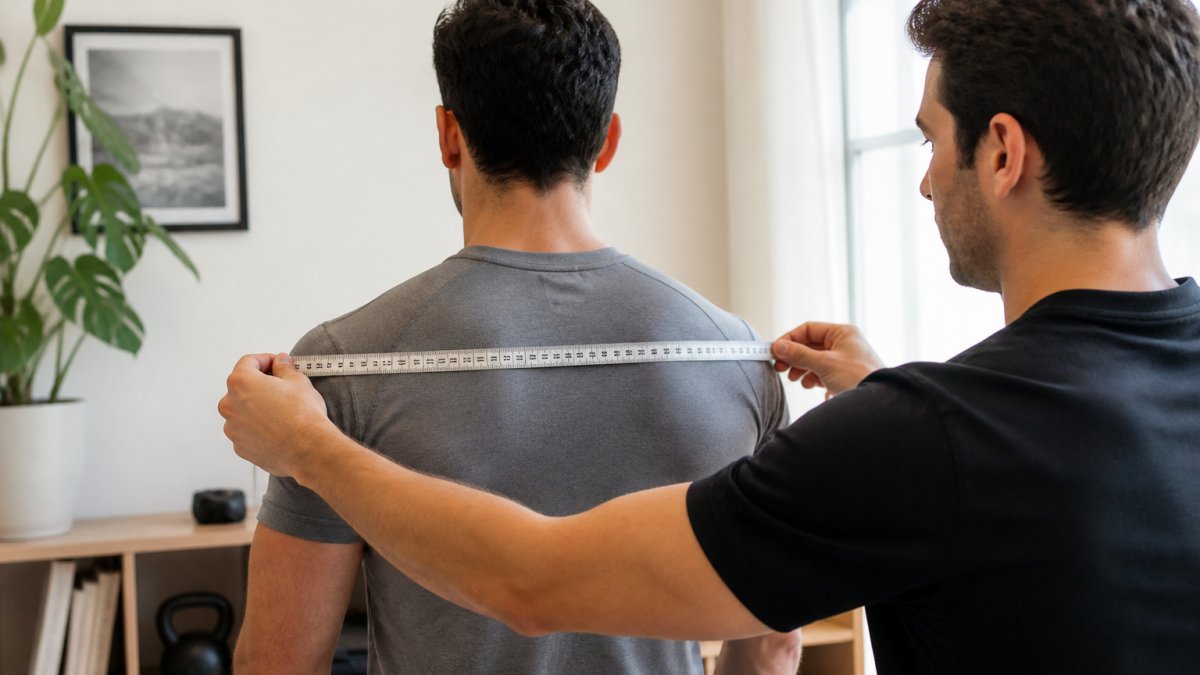
- Stand straight with your arms relaxed at your sides.
- Find the bony points at the top of each shoulder.
- Run the tape from one point to the other across your upper back.
- Keep the tape level and snug, not tight.
- Record the measurement in centimetres.
Then check the brand's size chart for the shoulder measurement, not just the chest. If the chart does not list shoulders, compare the chest measurement and be ready to size up or choose a muscle fit cut.
Check the Fit: Where the Shirt Should Sit
A shirt that fits well follows a few clear rules. Stand in front of a mirror and check each point.
- Shoulder seam: It should sit at the edge of your shoulder bone, not slide down your upper arm.
- Armhole: It should let you raise your arms without the fabric lifting your whole torso.
- Chest: It should be close but not tight enough to show strain lines.
- Length: It should cover your waistband when your arms are down.
Raise both arms straight out to the side, then overhead. If the shirt lifts above your waistband or the seams pull hard, the shoulders are too narrow. If the shirt bunches in the armpit, the armholes are too tight or too low.
Watch out: a shirt that fits only when your arms are down is not the right size. Always test movement in the fitting room or at home.
The table below sums up where a shirt should sit so you can check each point quickly.
| Point | Should | If it fails |
|---|---|---|
| Shoulder seam | Sits at the edge of the shoulder bone | Shoulders are too narrow |
| Armhole | Lets you raise arms without lifting the torso | Armholes are too tight or too low |
| Chest | Close but no strain lines | Chest is too tight |
| Length | Covers the waistband with arms down | Body is too short |
How to Stretch a Tight Shirt Safely
Sometimes you can gain a little room from a shirt you already own, especially one made from cotton with some elastane, since a shirt pulling shoulders can often be eased with care. Stretch it gently, and do not expect miracles.
- Wet the shirt in lukewarm water and squeeze out the excess.
- Lay it flat on a towel and smooth it into shape.
- Gently pull the shoulders outward, a little at a time.
- Let it dry flat, away from direct heat.
Do not hang it while wet, as the weight stretches the body and the shoulders unevenly. Do not use a hot dryer. Expect a few centimetres at most. If the shirt is made from stiff non-stretch fabric, it will not give much, and forcing it can tear seams. In that case, a better-fitting shirt is the real fix.
When Sizing Up Is the Wrong Fix
Sizing up is a tempting fix. It usually makes the shoulders fit and the rest of the shirt baggy. You end up with fabric bunching at the waist, sleeves that flare, and a silhouette that hides your build.
Consider sizing up only if your chest and shoulders both fall into the next size and the waist still fits. For broad shoulders, a muscle fit or athletic cut usually works better. Those shirts give room where you need it and keep the waist tailored.
Hyper Stretch Shirt In Grey Melange →
Some men also need the length or sleeve adjusted, not the whole shirt enlarged. Check the sleeve length and the body length before you decide to size up.
Best Shirts for Broad Shoulders
Our [Hyper Stretch Shirt In Pure White | fitizenjeans.com] uses a hyper stretch fabric with total freedom of movement and a tapered muscle fit that complements athletic shapes. The [Hyper Stretch Shirt In Jet Black | fitizenjeans.com] and [Hyper Stretch Shirt In Navy Blue | fitizenjeans.com] are also listed at £69.00 each.
Check the fabric content and care label before you buy.
Choosing a Shirt That Fits Your Shoulders From Day One
The easiest fix is buying the right cut in the first place. Use this checklist before you buy:
-
Measure your shoulders, chest and waist.
-
Compare with the brand's size chart, not just the label size.
-
Choose a muscle fit or athletic cut if your shoulders are wide.
-
Test arm movement before you leave the fitting room.
A shirt that fits through the shoulders does more than look better.
Frequently Asked Questions
Why does my shirt pull across the shoulders?
Shirts pull across the shoulders when the shoulder seam sits narrower than your actual shoulder width, or when the armholes and body are cut too tight for your frame. Broad shoulders, a developed upper back and muscular arms all add volume that a standard cut may not allow for. Check where the seam lands: if it sits above the edge of your shoulder bone or the fabric drags sideways towards the armhole, the shirt is too narrow across the shoulders.
Can you stretch a shirt that pulls at the shoulders?
Yes, but only to a limited degree, and mainly with knit or fabrics that contain elastane. Dampen the shirt, put it on, and gently work the shoulders forward and back while it dries, so the fibres relax into your shape. Avoid heat and hard pulling, which can distort seams and weaken the fabric. Stretching will not fix a shirt that is significantly too small, so if the seam still sits high after this, a better-fitting shirt is the more reliable answer.
Should I size up if a shirt is tight across the shoulders?
Sizing up often fixes the shoulders but leaves the body and sleeves too loose, which creates the baggy look many lifters and athletes want to avoid. A better option is to choose a size that fits your shoulders and then check the waist and chest. Look for a tapered or muscle-fit cut that gives room through the shoulders and back while narrowing towards the waist. Hyper-stretch fabric also helps, because it moves with you rather than restricting the shoulder area when you lift or reach.
What shirt fabric is best for broad shoulders?
Fabrics with some stretch, such as cotton blends with elastane or hyper-stretch knits, tend to suit broad shoulders best because they give through the upper body without losing their shape. Heavy woven cotton can feel stiff and pull across the back when you move. Choose a fabric with enough recovery that it springs back after you raise your arms, and check that the shoulder seam still sits on your shoulder bone when you are fully dressed.
