

Last Updated: October 29, 2026
Quick Summary
Fix a waist gap in denim by matching the method to the gap size: a hair tie or elastic cinch for gaps under 2 cm, a back waist dart for 2-4 cm, and a centre-back seam adjustment for gaps over 4 cm. No-sew fixes are temporary and best used to diagnose how much take-in you need.
- Measure the gap first: under 2 cm suits a hair tie, 2-4 cm a dart, over 4 cm a centre-back seam.
- A back waist dart takes about 45 minutes and is the cleanest fix for a 2-4 cm gap.
- The centre-back seam adjustment handles gaps over 4 cm and takes 1-2 hours at intermediate skill.
- Stretch denim recovers after washing, so take in less than you think you need and adjust.
- If the gap comes with hip gaping, the cut is wrong and no alteration will fully fix it.
Table of Contents
- Why Your Jeans Gap at the Waist (and Where)
- Try-On Fit Check: Measuring the Gap Before You Fix It
- No-Sew Jeans Waist Alteration: Quick Fixes That Hold
- How to Take In Jeans at the Waist: The Sewing Route
- Back Waist Dart Alteration for Jeans, Step by Step
- Adjusting the Center-Back Seam and Stretch Denim
- Choosing a Fix by Gap Size, Construction and Skill Level
- Shop Jeans Built for Your Waist and Thighs
- Frequently Asked Questions
Why Your Jeans Gap at the Waist (and Where)
A waist gap in denim is a fit mismatch, not a sizing failure. If you also notice shirt pulling at the shoulders, that points to a related fit issue worth diagnosing. The waistband is cut for a straighter hip-to-waist ratio than your body has, so the fabric stands away at the back even when the thighs and seat fit well.
The fix starts with finding where the gap happens, that decides whether you need a two-minute no-sew fix or a proper alteration.
Diagnosing the Gap: Back Waist, Side Seam or Hip
Stand side-on to a mirror in good light and pinch the excess fabric. Where does it gather?
- Back waist gap: fabric bunches at the centre-back seam, just below the belt loop. Most common cause: a curved lower back and fuller glutes pulling the waistband away.
- Side seam gap: the waistband flares at the hips rather than the spine. Usually a hip-to-waist ratio issue.
- Hip gaping: the denim pulls tight across the seat while the waist floats. This is a rise and cut problem more than a waistband one.
A back gap is the easiest to fix at home. Hip gaping often means the cut is wrong for you and no alteration will fully rescue it.
Try-On Fit Check: Measuring the Gap Before You Fix It
Measure before you cut anything. Put the jeans on, sit down, then stand and pinch the excess at the back waist between finger and thumb.
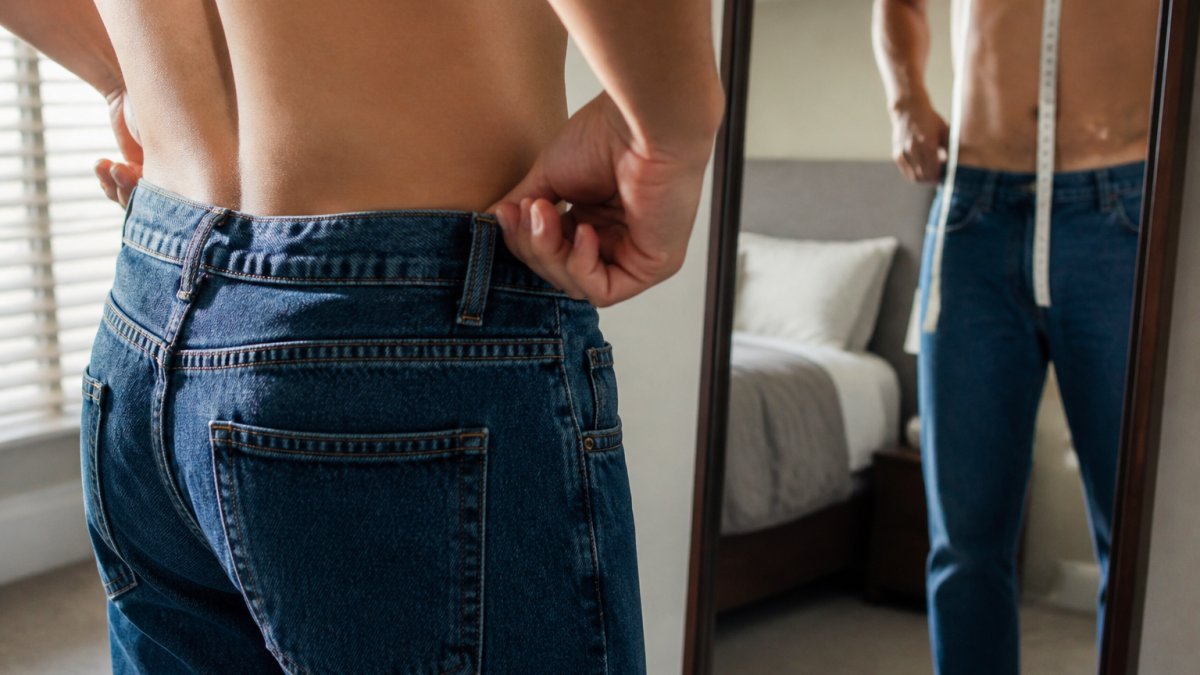
- Under 2 cm: a hair tie or elastic cinch will hold it.
- 2-4 cm: a back waist dart is the cleanest fix.
- Over 4 cm: adjust the centre-back seam, or accept the cut is wrong.
Check two more things in the mirror. Can you slide a flat hand under the waistband at the back? Does the denim dig into your hips or thighs?
If chafing is part of your fit problem, our guide on how to prevent inner thigh chafing in denim covers the practical side.
No-Sew Jeans Waist Alteration: Quick Fixes That Hold
A no-sew jeans waist alteration is any temporary fix that cinches the waistband without cutting fabric. These hold for a day or a night out, not forever, and are reversible in seconds, ideal for testing how much take-in you need before committing to a needle.
The honest trade-off: every no-sew fix is either visible, temporary, or both. Match the hack to the gap and know when to stop.
The hair tie and elastic cinch
The fastest waist gap fix costs nothing. Thread a hair tie or a short loop of elastic through the back belt loop, pull both ends through the loop, and hook them over your button.
- Works best on gaps under 2 cm
- Choose flat elastic over round cord, which digs in when you sit
- Slide the loop slightly off-centre if your gap sits to one side
Trade-offs: a tight elastic cinch pulls the centre-back seam into a pucker that shows under a fitted top.
Reversibility: remove the loop and the jeans return to their original shape. No damage to the belt loop if you use a flat elastic rather than a metal clip.
The button-and-hair-tie loop (no belt loop required)
If your jeans have no centre-back belt loop, or you do not want to stretch it, loop a hair tie around the button itself and hook the other end over a button or safety pin placed 2-3 cm to the side.
Trade-offs: the pull is asymmetric, so it can distort the fly. Use it for short wears, not all day.
Removing and reattaching belt loops
Belt loops can become part of the fix. On some jeans, the centre-back loop sits exactly where the fabric gaps, and moving it lets you gather the waistband more evenly.
- Slip a seam ripper under the stitching at the base of the loop.
- Snip the threads, not the denim, and lift the loop free.
- Pinch the waistband to your preferred fit and mark the new spot with tailor's chalk.
- Hand-sew the loop back with a matching thread and a few backstitches.
This is reversible and takes about ten minutes. It won't close a large gap on its own, but it makes an elastic cinch sit flatter.
Trade-offs: the old stitch holes may show on dark denim. Press with steam after removal and most will close.
The folded-and-pinned tuck (for trying before sewing)
Fold the excess fabric at the centre back into a flat pleat, pin it from the inside with two safety pins, and wear the jeans for an hour. This is not a fix you leave the house in, the pins can work loose, but it is the most accurate way to measure how much a dart or seam adjustment should remove.
Trade-offs: pins can scratch and can pop open when you sit. Use it as a fitting tool, not a solution.
DenimTech Jeans In Medium Wash →
Which no-sew fix suits which gap
| Gap type | Best no-sew fix | Holds for | Visible? |
|---|---|---|---|
| Centre-back gap under 2 cm | Hair tie through belt loop | A day | Slightly, under fitted tops |
| Side-waist gap | Button-and-hair-tie loop | A few hours | Yes, at the side |
| Any gap, for measuring | Folded-and-pinned tuck | An hour | Hidden inside |
| Gap over 2 cm | None reliably, move to a dart | , | , |
Durability and comfort checks
Before you rely on any no-sew fix, sit down, bend forward and walk a few steps. A cinch that holds standing often slips when you sit, and an elastic that feels fine in the mirror can dig in after an hour. Check the belt loop for stretching, flat elastic spreads the load, round cord concentrates it and will eventually pull the loop stitching loose.
How to Take In Jeans at the Waist: The Sewing Route
Sewing is the only route to a permanent, invisible waist gap fix.
You'll need a sewing machine or a sturdy hand-sewing kit, matching thread, pins, tailor's chalk, and a seam ripper. Set aside 45 minutes for a dart, longer for a centre-back seam.
If your jeans also need work through the thigh, our guide on how to tailor jeans for large thighs covers the leg side of the job so the waist fix doesn't spoil the fit below.
Back Waist Dart Alteration for Jeans, Step by Step
A back waist dart alteration for jeans is the cleanest fix for a 2-4 cm gap. A dart is a small triangular tuck sewn into the inside of the waistband that removes excess fabric without touching the outer seams.
- Try the jeans on inside out and pinch the excess at the centre back into a triangle, widest at the top edge.
- Mark the triangle with chalk: about 6-8 cm tall, tapering to a point.
- Pin along the marks and check the fit in a mirror before sewing.
- Stitch from the top edge down to the point, backstitching at both ends.
- Trim the seam allowance to about 1 cm and press the dart flat.
- Try on again and sit down. If it pulls, unpick and widen the dart by a few millimetres.
The dart is invisible from the outside because it sits inside the waistband. It also keeps the belt loops and topstitching untouched, which matters on darker washes where stitch marks show.
Adjusting the Center-Back Seam and Stretch Denim
The centre-back seam fix handles gaps over 4 cm. It is the only home alteration that removes a large wedge of fabric permanently, and it is the method most likely to go wrong, so read the whole sequence before you unpick anything.
What the centre-back seam adjustment actually does
You are not taking in the side seams. You are removing a vertical wedge from the seam that runs from the crotch up to the waistband at the centre back, then reattaching the waistband.
Expect to spend an hour or more, and practise on an old pair first. The job is unforgiving: a seam taken in too far cannot be let out once you have trimmed the allowance.
Tools and materials
- Sewing machine with a denim or heavy-duty needle (size 90/14 or 100/16)
- Matching thread, plus a spare bobbin
- Seam ripper
Step by step
- Try the jeans on inside out and pinch the excess at the centre back. Measure how much you need to remove at the top edge, typically 2-4 cm per side for a gap over 4 cm. Halve that figure: you will remove half from each side of the seam so the centre stays centred.
- Mark the new seam line with chalk, tapering from the top edge down to the existing seam at about the level of the crotch curve. Do not taper to a point too high, or the seat will pull.
- Unpick the waistband at the back only, from one side seam to the other, using the seam ripper. Work from the inside and lift the threads rather than cutting the denim.
- Unpick the centre-back seam down to your marked taper point.
- Pin the new seam on both sides, matching the original stitch line at the bottom and your chalk line at the top. Baste by hand if the fabric is slippery.
- Stitch from the taper point up to the top edge, backstitching at both ends. Use a slightly longer stitch length on denim.
- Trim the seam allowance to about 1 cm, press it open, then press it flat to one side.
- Reattach the waistband, easing it back into place. The waistband will now be slightly longer than the new seam opening, so distribute the excess evenly rather than forcing it into one spot.
- Topstitch the waistband back down, matching the original stitch line and thread colour.
- Try on and sit down. If the seat pulls or the fly distorts, unpick and reduce the take-in.
How stretch denim changes the rules
Stretch denim recovers after washing, so a seam taken in too tight can look strained once the fabric relaxes. Take in less than you think you need, try on, then adjust. Use a ballpoint or stretch needle and a stretch stitch, a narrow zigzag or a stretch stitch, or the seam will pop the first time you squat.
Troubleshooting the common failures
- Puckering along the new seam: the tension is too tight or the needle is too large for the fabric. Test on a scrap of the same denim first.
- Uneven gathers at the waistband: the waistband was reattached without distributing the excess. Unpick that section and re-pin in quarters.
- Visible stitch marks after unpicking: dark washes show old needle holes. Press with steam and a pressing cloth; most close up after a wash.
When to stop and use a tailor
If the gap comes with hip gaping, the cut is wrong for your proportions and no centre-back adjustment will fix a waistband that was never shaped for you. A tailor can recut the yoke, but at that point buying denim cut for your proportions is usually the better spend.
Choosing a Fix by Gap Size, Construction and Skill Level
Match the fix to the gap, not to the video that looked easiest. Here's how we'd choose:
| Gap size | Best fix | Time | Skill level | Reversible? |
|---|---|---|---|---|
| Under 2 cm | Hair tie or elastic cinch | 2 minutes | None | Yes |
| 2-4 cm | Back waist dart | 45 minutes | Beginner sewing | Partly |
| Over 4 cm | Centre-back seam adjustment | 1-2 hours | Intermediate | No |
| Wrong cut entirely | Buy jeans that fit the waist | None | None | N/A |
Two things shift the decision. Rigid denim holds a dart well; heavy stretch denim needs a gentler take-in. And if the gap comes with hip gaping, the cut is wrong for your proportions, and no amount of sewing will fix a waistband that was never shaped for you.
If you decide fixing isn't worth the hassle, our round-up of jeans that fit big thighs and a small waist is the shortcut.
Shop Jeans Built for Your Waist and Thighs
The most reliable waist gap fix is buying denim cut for your proportions in the first place. DenimTech jeans are built with hyper stretch denim and a muscle-fit design for athletes, lifters and bodybuilders, so there's no gap to sew shut.
- DenimTech Jeans in Medium Wash (£89.00): breathable, sweat-wicking, and a best seller
- DenimTech Jeans in Dark Wash (£89.00): limited edition, smart enough for the office
- DenimTech Jeans in Medium Wash, Surplus Sale (£49.50): same cut at half price
Every pair is designed to highlight your physique rather than hide it, with freedom of movement for activities like squatting and walking. If you're ready to skip the needle and thread, browse the hyper stretch jeans built for athletic builds.
Frequently Asked Questions
Why is there a gap at the back of my jeans?
A back waist gap usually comes from a mismatch between your hip and waist measurements. Jeans cut for straighter proportions leave extra fabric at the centre-back seam when your glutes and thighs fill the leg but your waist is narrower. Stretch denim makes it worse because the fabric relaxes with wear. Check where the gap sits: a gap at the centre-back seam calls for a dart or seam adjustment, while side gaps point to the side seams.
How do I take in the waist of jeans without a sewing machine?
A no-sew jeans waist alteration works well for gaps under about 3 cm. Thread a hair tie or a 15 cm length of elastic through the back belt loop, loop it around the button and fasten, which gathers the excess fabric invisibly under a top. For a more permanent result, fold the centre-back seam flat and stitch it by hand with a needle and matching thread, pressing the seam allowance open afterwards. Both take under 15 minutes.
Will a back waist dart alteration for jeans ruin the fit?
Done correctly, a back waist dart removes only the excess fabric and keeps the seat and thighs untouched. Pin the dart on the inside while wearing the jeans, mark it with chalk, then stitch from the waistband down to a point about 7 to 10 cm below. Keep both darts symmetrical and try the jeans on again before trimming any seam allowance. If the waistband itself gapes, adjust the centre-back seam instead of adding darts.
Can I fix a waist gap on stretch denim jeans?
Yes, but stretch denim needs a stitch that moves with the fabric. Use a stretch or zig-zag stitch and leave a slightly wider seam allowance than you would on rigid denim. Avoid over-tightening, and take in roughly 1 cm less than the gap measures so you can check the fit after a day of wear. If the gap keeps returning, a pair cut for athletic proportions, such as Fitizen's DenimTech jeans at £89.00, is an option to consider.
Got a drawer full of jeans that fit your thighs but swim at the waist? Fitizen makes muscle-fit denim with hyper stretch fabric, a cut that contours to your body, and breathable, sweat-wicking technology for all-day wear. Get started with Fitizen and wear jeans that fit the way you're built.
