

Last Updated: October 31, 2026
Quick Summary
Waist gap at the back of high-waisted jeans happens when the waistband is wider than your waist, so the jeans slide away when you sit or bend. Prevent it by choosing a cut built for a curved shape with a higher back rise, rather than sizing up. A moderate gap can be fixed by taking in the centre-back seam.
- Measure your natural waist and fullest hips, then compare to the size chart, not the label size.
- Check the back waistband in the mirror while you sit, squat and bend in the changing room.
- Do not size down to close the gap, because it tightens the hips and seat.
- Take in the centre-back seam in small passes of about 1 cm, then try the jeans on again.
- Stretch denim can pucker if you pull it through the machine, so let the feed dogs move the fabric.
Table of Contents
- Why High-Waisted Jeans Gape at the Back in the First Place
- How to Prevent Waist Gap When You Buy Jeans
- Measuring Your Waist Gap and Choosing the Right Fix
- Quick Temporary Fixes: The Jeans Waistband Gap Hack
- How to Take In Jeans at the Waist Step by Step
- How to Fix Waist Gap in Jeans Without Losing Their Shape
- Choosing Jeans With a Small Waist and Big Hips in Mind
- Booking Your Next Pair of Hyper Stretch Jeans
- Frequently Asked Questions
Why High-Waisted Jeans Gape at the Back in the First Place
Gaping at the back of high-waisted jeans happens when the waistband is wider than the wearer's waist at the back.
Waist gap is common in high-waisted cuts. The rise sits at or above the natural waist, so the back panel must curve over the hips.
Here is what usually causes it:
- The jeans are cut for a straight waist, not a curved one
- The rise is too long for your torso
- The fabric has lost its shape after washing
A common mistake is sizing up to fix the hips. That usually makes the gap worse.
How to Prevent Waist Gap When You Buy Jeans
Prevention is easier than repair. Most waist gap problems can be avoided at the shopping stage.
Start with the waist-to-hip difference. If your hips are noticeably larger than your waist, look for cuts built for that shape rather than sizing up.
Checking the Waist-to-Hip Fit Before You Buy
Measure your natural waist and the fullest part of your hips. Compare those numbers to the jeans' size chart, not just the label size.
Then check these things in the changing room:
- Stand, sit and squat in the jeans
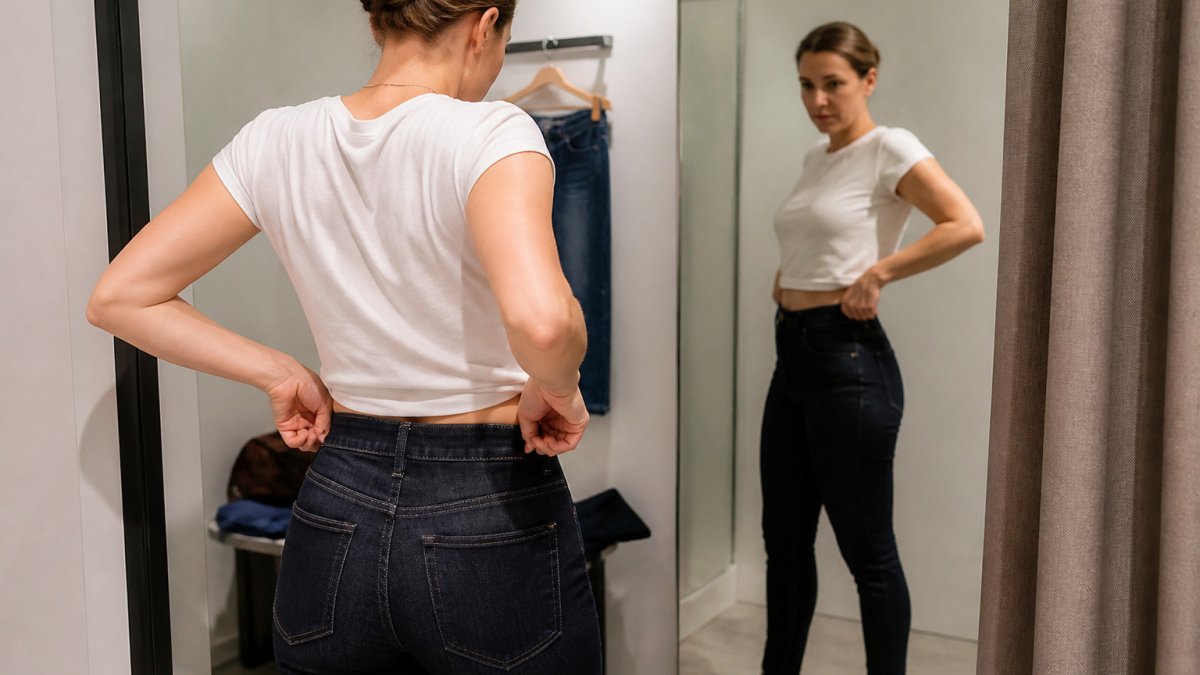
- Turn around and look at the back waistband in the mirror
- Check whether the waistband stays put when you bend forward
If the back waistband lifts or gaps when you sit, the jeans are not right for your shape.
!A woman in her thirties standing in a bright changing room, checking the fit of dark high-waisted jeans at the back waistband in a mirror
Choosing Fabric and Stretch That Holds Its Shape
Stretch helps the jeans move with you. But stretch alone is not enough. Look for denim that recovers well after sitting and bending.
Look for stretch denim with good recovery; the Hyper Stretch Jeans In Deep Blue are one option built for athletic bodies.

Measuring Your Waist Gap and Choosing the Right Fix
The right fix depends on two things you can measure in five minutes: how big the gap actually is, and how the jeans are built.
Step 1: Measure the gap properly
Do this in good light, wearing the jeans as you normally would, with the pockets and fly sitting where they should.
- Button the jeans and stand naturally, do not suck in or push your stomach out.
- Slide a flexible tape measure or rigid ruler horizontally across the back waistband at its widest point of separation.
- Record the distance between the waistband and the small of your back in centimetres.
- Sit down and repeat. A gap that opens when you sit needs a different fix from one that stays constant.
- Bend forward and note whether the waistband lifts away or stays put.
Write the numbers down. You will compare them after any alteration.
Step 2: Compare waist and hip measurements
Measure your natural waist, the narrowest point, usually just above the navel, and the fullest part of your hips, keeping the tape level. The difference tells you what shape of jeans you need, not just what size.
- Waist-to-hip difference under about 15 cm: most standard high-rise cuts will sit reasonably close at the back.
- Difference of roughly 15-25 cm: look for curvy-fit or athletic-fit cuts with a shaped back yoke and a slightly higher back rise.
- Difference over about 25 cm: standard waistbands will almost always gape; prioritise cuts designed for a defined waist and fuller hip, or plan for an alteration.
These bands are a starting point, not a rule. Two people with the same measurements can need different cuts because torso length and seat shape change how a waistband sits.
Step 3: Read the garment before you choose a fix
Look at the inside of the waistband and the centre-back seam. What you find there decides which fixes are safe.
- Centre-back seam present and accessible: taking in this seam is the most durable fix for a moderate gap.
- No centre-back seam (a single continuous waistband): the waistband has to be reshaped or an insert added.
- Belt loops sitting on the seam: they will need removing and re-attaching, which adds time and visible stitch holes.
Step 4: Match the fix to the gap and the garment
| Gap at the back waist | Fabric and construction | Sensible first fix |
|---|---|---|
| Under about 2 cm | Any | Hair tie or elastic across the back belt loops, or a small hidden safety pin |
| About 2-4 cm | Stretch denim with a centre-back seam | Take in the centre-back seam in small passes |
| About 2-4 cm | Non-stretch denim with a centre-back seam | Take in the centre-back seam, then press the seam flat |
| Over about 4 cm | Any high-rise cut | Tailor adjustment, or an elastic insert set into the waistband |
| Any size | No centre-back seam | Elastic insert, adjustable waistband product, or a tailor |
A gap of roughly a finger's width is the easy end of the scale. Once it passes two fingers, a seam adjustment alone often pulls the pockets out of line, and a tailor or an insert is the better route.
Quick Temporary Fixes: The Jeans Waistband Gap Hack
Temporary fixes work well for a short-term solution. They will not hold up to heavy wear, so treat them as stopgaps.
A common quick fix is a hair tie or small elastic. Here is how to use one:
- Put on the jeans
- Thread a hair tie through the back belt loop on one side
- Pull it across the gap and loop it through the loop on the other side
- Adjust until the back waistband sits flat
You can also use a small safety pin on the inside of the waistband. Keep it hidden so it does not poke you.
Hyper Stretch Jeans In Deep Blue →
These fixes have limits. They can show under a loose top and stretch out after a few wears.
How to Take In Jeans at the Waist Step by Step
Taking in the back waistband is the most reliable way to fix a gap that will not go away. It takes about 60 to 90 minutes if you are comfortable with a sewing machine.
What you will need:
- Sewing machine and matching thread
- Pins or clips
- Tape measure
Steps:
- Turn the jeans inside out and try them on
- Pin the excess fabric at the centre-back seam, working from the waistband down
- Check that the pinned seam sits flat and does not pull the fabric
- Mark the new seam line with chalk
- Remove the belt loops if they sit on the seam
- Use the seam ripper to open the original stitching
- Sew the new seam along your chalk line, backstitching at each end
- Trim the excess fabric to about 1 cm
- Re-attach the belt loops and try the jeans on again
Stitch in small steps. Taking in too much at once can make the waistband pucker.
How to Fix Waist Gap in Jeans Without Losing Their Shape
Closing the gap is the easy part. Keeping the jeans looking and feeling like the pair you bought is where most home alterations go wrong.
Risk 1: Puckering along the new seam
Puckering happens when you sew a curved seam as if it were straight, or when the seam allowance is too wide for the fabric. On a high-rise waistband the centre-back seam curves over the base of the spine, so the fabric has to ease around that curve. Mastering the tension required to accommodate these anatomical contours is a foundational skill that also helps prevent leggings from rolling down during movement.
- Sew in short runs, lifting the presser foot at corners rather than pivoting through them.
- Keep the seam allowance to about 1 cm; wider allowances bunch inside the waistband.
- Press the seam open over a curved surface, a tailor's ham or a rolled towel, rather than flat on an ironing board.
Risk 2: Damaging stretch recovery
Stretch denim contains elastane, and elastane does not like being stretched while it is sewn. If you pull the fabric through the machine, the seam will ripple when it relaxes.
- Use a stretch or ballpoint needle and a slightly longer stitch length.
- Let the feed dogs move the fabric; do not tug it.
- Take in no more than about 1 cm per pass, try the jeans on, then take in more if needed.
Risk 3: Moving the pockets and belt loops
Taking in the centre-back seam pulls the back pockets closer together and shifts the belt loops inward. On jeans with decorative stitching or a faded seat, that shift is visible even from a distance.
- Take in only as much as the gap requires, usually 1-2 cm per side is enough for a moderate gap.
- If the pockets end up too close, consider taking a little from each side seam instead, which spreads the change.
- Remove belt loops that sit on the seam before sewing and re-attach them in their original positions, matching the original thread colour.
Risk 4: Flattening the seat and back rise
A waistband taken in too aggressively pulls the back rise upward and flattens the curve over the seat. The jeans then feel tight across the back and loose at the waist, the opposite of the fix you wanted.
Check the back rise before and after: sit down, and make sure the waistband still sits at your natural waist rather than riding up. If it rides up, you have taken in too much.
Risk 5: Losing the original shape of the waistband
A high-rise waistband is shaped, not straight. Sew a straight seam through a shaped band and it loses its curve and stands away at the sides.
- Follow the existing curve of the waistband when marking your new seam line.
- Keep the top edge of the waistband level; an uneven top edge is the most obvious sign of a home alteration.
- If the waistband has a curved seam at the back, take in along that curve rather than cutting across it.
When to stop and hand it to a tailor
A tailor is the right call if any of these apply:
- The gap is wider than about 4 cm.
- The jeans have no centre-back seam.
- The waistband is heavily shaped or has an elastic panel.
A good tailor will usually take in the centre-back seam and reshape the waistband rather than simply sewing a straight line, and will match the thread and stitch length to the original. Ask them to show you the pinned fit before they sew.
Choosing Jeans With a Small Waist and Big Hips in Mind
If you have a small waist and bigger hips, the right cut can prevent most gaping before it starts.
Check the back rise and hip measurement on the size chart. Pick the size that fits your hips, then check the waist.
Stretch denim with good recovery is another useful feature. It moves with the body and keeps its shape through the day.
The Hyper Stretch Jeans In Indigo Wash and Hyper Stretch Jeans In Jet Black are both in the Fitizen range and built for athletic bodies.


Booking Your Next Pair of Hyper Stretch Jeans
Once you know your size and cut, the next step is choosing a pair. Fitizen's Hyper Stretch Jeans are designed for athletic builds.
Compare the colours and pick the one that suits your wardrobe:
- Hyper Stretch Jeans In Light Wash, £89.00
- Hyper Stretch Jeans In Jet Black, £89.00
- Hyper Stretch Jeans In Indigo Wash, £89.00
Check the size chart before you order, and use the waist-to-hip steps above to pick the right size.
Frequently Asked Questions
Can a tailor fix the waist gap in jeans?
Yes. A tailor can take in the centre-back seam and adjust the waistband so the jeans sit flat against the lower back. Most alterations to the waist are a straightforward job, and the cost depends on how much fabric needs removing and whether the waistband needs rebuilding. Ask the tailor to check the fit while you are wearing the jeans, sitting and bending, because a waistband that looks right standing can still pull or gape when you move. If the jeans have a stretch fabric, let the tailor know, since stretch denim can pucker after alteration.
Can I alter jeans to make the waistband smaller?
You can, provided the gap is moderate. Taking in the centre-back seam and reducing the waistband width are the usual methods, and both work best when the jeans have some room in the seat and thighs. If the gap is large, altering the waist alone can distort the rise and the back pockets. Check the fit before cutting anything, and keep the original seam allowance so you can let the jeans out again if the first attempt is too tight.
Why do high-waisted jeans gap at the back?
High-waisted jeans gap at the back when the waistband is wider than the wearer's natural waist at the back, or when the rise is cut too long for the body. A gap is more likely in jeans that fit the hips and thighs well, because the waist is the part that has to be taken in. Checking the waist-to-hip difference before buying reduces the problem more than any fix afterwards.
How can I tighten a loose jeans waist without sewing?
A hair tie or a short length of elastic threaded through the back of the waistband can take up a small gap for a day. Thread the elastic through the belt loops or waistband seam, pull it to the right tightness, and secure both ends. This is a temporary fix, so it suits a small gap and occasional wear. For a gap that returns every time you wear the jeans, a permanent alteration gives a more reliable result.
