

Table of Contents
- What Active People Jeans Actually Are
- Why Standard Jeans Fail Athletic Builds
- Fit and Silhouette Options for Jeans for Athletic Builds
- Fabric, Stretch, and Construction That Matter
- Free People Jeans and Relaxed Silhouettes in the Market
- Free People Baggy and Barrel Jeans: When Oversized Fits Fall Short
- Durability, Wash Retention, and Real-World Performance
- Choosing Active People Jeans: Key Factors
- Frequently Asked Questions
Last Updated: October 6, 2026
What Active People Jeans Actually Are
Active people jeans are designed for athletes, lifters, and anyone with a muscular build who struggles to find denim that fits. They prioritize stretch, room through the thigh and glutes, and a tailored silhouette that doesn't balloon at the waist.
Most jeans are cut for average proportions.
At Fitizen, our entire collection is built around this principle: hyper-stretch denim that accommodates muscular legs without sacrificing a clean, tailored look, the comfort of gymwear with the style of proper denim.
Why Standard Jeans Fail Athletic Builds
Standard jeans are engineered for relatively even proportions from waist to thigh. For athletes, that's a disaster.
When you've built significant muscle in your quads, glutes, and hamstrings, regular denim creates pressure points: the fabric stretches across your thighs but pulls tight, restricting movement.
Construction matters too. Most affordable jeans use cotton-heavy blends with minimal elastane, so squatting, climbing stairs, or even sitting down can feel restrictive, the fabric isn't built for your range of motion.
Fit and Silhouette Options for Jeans for Athletic Builds
Active people jeans come in several silhouettes. The right choice depends on your body type, how much room you need, and the look you want.
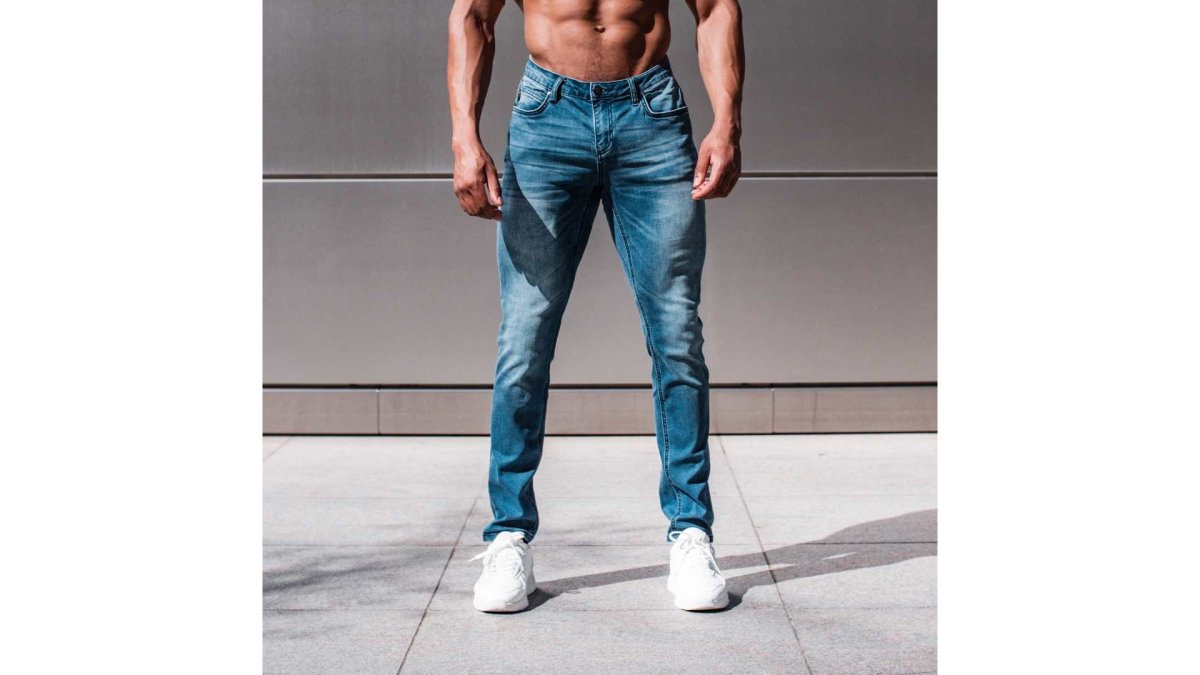
Slim fit with stretch through the thigh
Slim-fit active people jeans are cut close to the body but engineered with extra room through the thighs and glutes, the most popular option for athletes, delivering a tailored silhouette without restriction.

The key is the stretch blend. Fitizen's DenimTech Jeans in Medium Wash and Indigo Wash (£89.00 each) use hyper-stretch denim with thermo-regulating and sweat-wicking technology, so the fabric moves with you.
Slim-fit active jeans suit well-defined legs and a modern, fitted look, and work for casual wear, gym-to-street styling, and semi-professional settings.
Straight cut for extra room
Straight-cut active people jeans offer more room through the leg while keeping a clean silhouette, maintaining consistent width from hip to hem instead of tapering at the ankle.
The Straight Cut Jeans in Midnight Wash (£89.00) use the same hyper-stretch denim with extra room throughout, ideal if you prefer a relaxed aesthetic or have pronounced leg development, with freedom of movement but no baggy look.
Straight cuts suit CrossFit athletes, powerlifters, and anyone prioritising comfort and movement range over a fitted silhouette, pairing easily with casual wear and gym attire.
Jogger jeans for comfort and style
Jogger jeans blur the line between denim and activewear, with an elasticated waistband, drawstring, and often a tapered ankle, jeans style with jogger comfort.
The Jogger Jeans in Deep Blue (£66.75) include a fleece-lined interior and elasticated waist, comfortable denim style without restriction, ideal for lounging, gym sessions, or casual outings.
The trade-off: jogger jeans read more casual than traditional denim and suit professional or smart-casual settings less well, but for everyday athletic wear they're hard to beat.
Fabric, Stretch, and Construction That Matter
The difference between active people jeans and standard denim comes down to four measurable things: fibre composition, fabric weight, stretch percentage, and seam construction. Almost no competitor explains what to look for on the label, so here's the practical buying guide.
Fibre composition
Traditional denim is typically 98-100% cotton, structured and abrasion-resistant but with almost no give. Active people jeans trade some cotton for stretch fibres, usually elastane (also sold as Lycra or spandex) plus polyester or viscose for softness and shape retention.
Athletic-fit denim commonly runs roughly 70-92% cotton, 6-20% polyester or viscose, and 2-12% elastane. Higher elastane means more movement but more sag if the weave is poor, so composition alone isn't enough; check how the stretch is built in.
Fabric weight
Denim weight is measured in ounces per square yard (oz): lightweight sits around 8-10 oz, midweight 11-13 oz, heavyweight 14 oz upward. For active people jeans, midweight is the sweet spot, enough body to hold a clean silhouette, light enough to move and breathe. Heavyweight raw denim resists movement until broken in, defeating the purpose.
Stretch percentage and recovery
Stretch percentage tells you how far the fabric extends; recovery tells you whether it snaps back. A poorly woven 8% blend can bag out at the knees within a few wears. Look for 'four-way stretch' or 'high-recovery' wording and a stated stretch percentage. As a rule of thumb:
- 1-3% elastane: minimal stretch, closest to traditional denim.
- 4-7% elastane: comfortable everyday stretch, good for casual wear.
- 8-12% elastane: maximum mobility, best for gym-to-street and training-adjacent use.
Seam and pocket construction
Standard jeans use flat-felled seams for low-movement wear. Active people jeans reinforce where stress concentrates: inner thigh, crotch gusset, seat, and back rise. A crotch gusset, an extra panel sewn into the join, is the clearest sign a pair is engineered for movement rather than just marketed as stretchy. Look also for bar-tacked pocket corners and double-stitched belt loops.
Wash retention and colour
Black and indigo denim fade fastest because surface dye sits on top of the yarn; sulphur-dyed or yarn-dyed denim holds colour longer because the dye penetrates the fibre. Look for 'colour-locked', 'stay-black', or 'yarn-dyed' wording, and wash inside out in cold water.
Fitizen's DenimTech range uses a midweight hyper-stretch blend with elastane woven through the yarn rather than applied as a surface coating, so the stretch recovers wash after wash.
DenimTech Jeans In Medium Wash →
UK guidance on textile fibre labelling and care symbols
Free People Jeans and Relaxed Silhouettes in the Market
Free People jeans take a different approach to relaxed denim, emphasising oversized, vintage-inspired fits with distressed details or unique washes, an aesthetic that appeals to some athletes, with trade-offs.
Relaxed silhouettes work for a deliberately loose, fashion-forward look.
Relaxed denim offers comfort and style flexibility, but for athletic builds the proportions rarely work without significant tailoring. Fitizen builds athletic proportions into the cut itself.
Free People Baggy and Barrel Jeans: When Oversized Fits Fall Short
Baggy and barrel jeans are popular but challenging for athletes: baggy jeans sit low on the hips with excess fabric throughout the leg, while barrel jeans taper dramatically at the ankle while staying loose through the thigh.
The trade-off between comfort and proportion
Baggy and barrel silhouettes prioritise comfort and fashion over flattering fit, a trade-off that rarely favours muscular builds.
Between a well-fitted active people jean and a baggy or barrel option, the active fit wins for most athletes: comfort, movement, and a silhouette that reflects your physique.
Fitizen's straight-cut and slim-fit options offer relaxed denim comfort without sacrificing proportion, room where you need it, a clean silhouette everywhere else.
Durability, Wash Retention, and Real-World Performance
Active people jeans need to withstand intense activity. Standard denim often fails because seams aren't reinforced for high-movement stress, and the fabric breaks down faster with sweat and washing.
Wash retention matters too. Fitizen's Stay Black jeans hold their colour, so your investment keeps its appearance longer.

Moisture management matters too: sweat-wicking technology keeps you dry, slows fabric degradation, and keeps you comfortable all day.
Choosing Active People Jeans: Key Factors
Most jeans guides say 'find your fit' and stop there. Athletes need a repeatable method: measure, compare, adjust. Use this sequence to shop active people jeans online with far less guesswork.
Step 1: Measure three points, not one
Waist size alone is useless for athletic builds. Take three measurements with a soft tape:
- Natural waist, the narrowest point, usually just above the navel.
- Seat/hip, the fullest point around the glutes.
- Thigh, the widest point of the upper thigh, standing relaxed.
Write these down. Most fit problems come from a large waist-to-thigh gap, and knowing both numbers tells you whether a cut will work before you order.
Step 2: Match the cut to your thigh-to-waist ratio
As a rough guide, if your thigh measurement is more than about 10 cm larger than half your waist measurement, you're in athletic-fit territory and should prioritise stretch percentage over waist number. If the gap is smaller, standard slim or straight cuts may work with modest stretch.
Step 3: Understand the fit names
Fit labels are not standardised across brands, but the general pattern is:
- Slim / skinny: close through the leg, most reliant on stretch to work for muscular builds.
- Straight: consistent width from hip to hem, more forgiving through the calf and knee.
- Relaxed / loose: extra room throughout, can swamp athletic proportions if not cut for them.
- Athletic / tapered: room through the seat and thigh, tapering below the knee, the cut most active people jeans use.
- Jogger: elasticated waist and cuffs, closest to activewear in feel.
Step 4: Check sizing consistency before you buy
Because fit names vary, always check the brand's own size chart rather than assuming your usual number. Look for a stated waist measurement in centimetres, an inseam length, and a thigh measurement if offered. If a brand only lists S/M/L, treat that as a warning sign.
Step 5: Weigh price against cost per wear
Fitizen's active people jeans sit between £66.75 (Jogger Jeans in Deep Blue) and £89.00 (DenimTech and Straight Cut options). A cheaper pair that bags out, fades, or splits at the crotch within a season often costs more per wear than a well-engineered pair lasting several years.

Step 6: Match the silhouette to the occasion
- Slim and straight cuts work for casual wear, gym-to-street styling, and semi-professional settings.
- Jogger jeans suit lounging, training, and casual outings but read too relaxed for smart-casual dress codes.
- Relaxed and baggy cuts are a fashion choice first; for athletic builds they usually need tailoring to avoid swamping your proportions.
Step 7: Check the returns policy
Fit is the hardest thing to judge online. Before ordering, confirm the return window, whether returns are free, and whether you can exchange for a different size or cut. Under UK distance-selling rules, online clothing purchases normally come with a 14-day right to cancel from the day you receive the goods, provided items are unworn with tags attached.
UK consumer rights on returning online purchases
Frequently Asked Questions
What exactly are active people jeans?
Active people jeans are denim designed specifically for athletes, lifters, and bodybuilders with muscular thighs, glutes, and shoulders. They feature hyper-stretch fabrics and athletic fits that accommodate larger muscle groups while maintaining a tailored silhouette. Unlike standard jeans, active people jeans provide freedom of movement for squatting, walking, and intense training without excess bagginess at the waist.
Will jeans for athletic builds actually fit through the thigh without being baggy at the waist?
Yes, when designed properly. Jeans for athletic builds use contoured patterns that taper the waist while expanding through the thigh and glute. Hyper-stretch denim allows the fabric to move with your body rather than against it. Slim-fit and straight-cut options typically deliver the best balance, preventing the bagginess you'd get from sizing up in standard jeans.
How durable is hyper-stretch denim for intense training?
High-quality hyper-stretch denim holds up well during CrossFit, weightlifting, and daily wear. Look for jeans with reinforced seams and fabrics that retain their shape after multiple washes. Fitizen's DenimTech and Hyper Stretch ranges are engineered to maintain elasticity and colour through repeated wear and washing.
Can active people jeans work for both gym and office settings?
Absolutely. Jeans designed for athletic builds can transition from gym to office when you choose darker washes and tailored fits. Black or indigo denim with a clean, fitted silhouette reads as professional casual. Pair them with appropriate tops and footwear, and the athletic fit becomes an asset, you'll look sharp without the discomfort of restrictive standard jeans.