

Table of Contents
- What You'll Need Before You Start Shopping
- How to Measure Shoulder Width for Shirts Correctly
- The 3 Fit Issues That Ruin Shirts for Broad Shoulders
- Tapered Fit vs Slim Fit for Broad Shoulders: Which Wins?
- Best Shirts for Athletic Build: Fabric and Stretch Science
- Necklines, Collars, and Details That Balance Your Silhouette
- Common Mistakes to Avoid When Buying Off-the-Rack
- Conclusion: Build a Shirt Collection That Fits Your Frame
- Frequently Asked Questions
Last Updated: September 7, 2026
Learning how to find shirts for broad shoulders starts with understanding why the process is a frustrating cycle of tight armholes, pulling across the back, and fabric that gaps at the waist. The problem isn't your body; it's that most off-the-rack shirts are cut for a straight, narrow torso rather than an athletic one. This guide from Fitizen explains how to find shirts for broad shoulders by focusing on measurement, fabric science, and construction details.
Most men assume they need to size up to solve this problem. That's the first mistake. Sizing up adds fabric where you don't need it, usually in the waist and sleeves, while doing little to fix the chest and shoulder restriction. The real solution is understanding your torso proportions and buying shirts cut with a tapered fit that accommodates a wider chest without turning the midsection into a tent.
What You'll Need Before You Start Shopping
Before you browse another rack, gather three things: a soft fabric tape measure, a friend to help, and a well-fitting shirt you already own. The friend matters more than you think. Measuring your own shoulder width is awkward and usually inaccurate because you naturally hunch or twist.
You also need to know your chest circumference and your natural waist measurement. These three numbers form the basis of every fit decision you'll make. When you shop online, compare them against the garment measurements on the size chart rather than relying on the generic S, M, L labels, which vary wildly between brands.
How to Measure Shoulder Width for Shirts Correctly
Finding your true shoulder width is the single most important step in this entire process. A measurement error of just 1.5 cm can mean the difference between a shirt that drapes cleanly and one that pulls at the armhole (peer-reviewed research). Here is the exact protocol to follow.
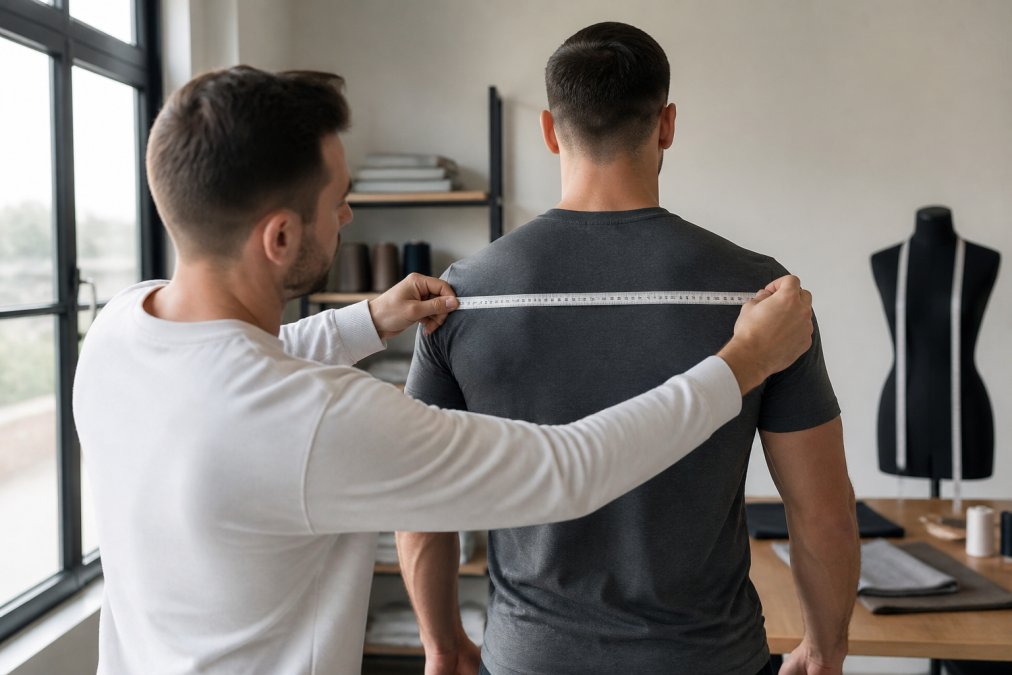
The Precise Measurement Protocol
- Posture Check: Stand with your back straight, arms hanging naturally at your sides, and your shoulders relaxed. Do not puff your chest out or roll your shoulders forward. This is the posture a shirt is designed for.
- Locate the Acromion: Have your helper feel for the bony prominence at the top of your shoulder, where the shoulder blade meets the collarbone. This is the acromion process. It is the exact point where the shoulder seam of a well-fitted shirt should sit.
- The Tape Placement: Place the end of a soft tape measure at the outside edge of the left acromion. Run the tape straight across the back, following the natural horizontal line of your shoulders, to the outside edge of the right acromion.
- Keep it Level: The tape must be taut and level. Do not let it dip down your back or curve around the roundness of your shoulders. You are measuring the straight-line distance between the two bones, not the contour of your body.
- Record and Repeat: Note the measurement in centimetres. Repeat the process twice to ensure accuracy. If the two readings differ by more than 0.5 cm, re-do it. The average of the two closest readings is your true shoulder width.
Troubleshooting Common Errors
- The "Too Far Down the Arm" Error: This is the most frequent mistake. If the tape slides down onto the deltoid muscle (the rounded part of your upper arm), you will add 2-4 cm to your measurement (the CDC). This leads you to buy a shirt with a shoulder seam that falls off your shoulder, creating a sloppy, oversized look.
- The "Hunched Back" Error: If you are measuring yourself without a helper, you will naturally hunch forward to see the tape. This rounds your shoulders and can reduce the measurement by up to 2 cm, leading to a shirt that is too tight across the back.
- The "Clothing Interference" Error: Always measure over a thin t-shirt or bare skin. Measuring over a thick jumper adds bulk and skews the result.
Translating the Measurement to a Garment
A shirt's stated shoulder width on a size chart is the measurement from seam to seam across the back. For a perfect fit, the shirt's shoulder measurement should be within 1 cm of your own measurement. If it is 2 cm wider, the seam will droop; if 2 cm narrower, it will pull and restrict movement.
The "Well-Fitting Shirt" Shortcut
If you own a shirt that fits perfectly across the shoulders, you can skip the body measurement and measure the shirt instead. Lay it flat on a table, buttoned up, and measure from the outside edge of the left shoulder seam to the outside edge of the right shoulder seam, straight across the back. Use this number as your baseline target when shopping online; it accounts for the specific ease a shirt needs.
The 3 Fit Issues That Ruin Shirts for Broad Shoulders
Three specific problems ruin shirts for men with a muscular upper body. The first is a boxy silhouette. When a shirt is cut straight from the chest to the hem, it hangs like a rectangle, creating excess fabric at the waist that looks sloppy and hides your shape.
The second issue is restricted armhole mobility. Shirts with high, tight armholes limit how far you can raise your arms. The armhole depth dictates how much the sleeve can move, so a shirt that fits when you stand still can feel like a straitjacket when you reach for something on a high shelf.
The third problem is pulling at the shoulder seam. When the chest is too tight, the fabric stretches horizontally across your back, causing the seams to strain and the collar to gap. This signals that the garment is structurally stressed, which shortens its lifespan. Each issue points to the same root cause: a shirt cut for a body shape that isn't yours.
Tapered Fit vs Slim Fit for Broad Shoulders: Which Wins?
The debate between tapered fit vs slim fit for broad shoulders has a clear answer for most athletic builds: tapered fit wins. A slim fit shirt is cut close to the body throughout, which can be too tight across the chest and shoulders while still being loose in the waist for someone with a significant drop. A tapered fit shirt is cut wider in the chest and shoulders but narrows deliberately through the waist, creating a V-shape that follows your natural torso proportions.
Slim fit assumes a uniformly lean body; tapered fit assumes a muscular upper body with a narrower waist, exactly the body type of most lifters and athletes. Look for the waist suppression, the difference between the chest and hem measurements. A well-designed tapered shirt will have a pronounced suppression, creating a clean, tailored line without bespoke tailoring.
Best Shirts for Athletic Build: Fabric and Stretch Science
The best shirts for athletic build share one non-negotiable feature: stretch. But not all stretch is created equal. Most shirts labelled "stretch" use a small percentage of elastane, usually around 2 to 3 percent, which offers minimal give (peer-reviewed research). For a muscular build, you need a higher stretch factor that provides genuine mobility.
The Science of the Blend
The magic is not just in the presence of elastane, but in the ratio and the base fibre it's blended with. Here is what to look for on the care label:
- Cotton with 4-6% Elastane: This is the sweet spot for everyday shirts. The cotton provides breathability and a crisp look, while the higher elastane content allows the fabric to flex without losing its shape. This prevents the horizontal pulling across the back when you reach forward.
- Cotton-Polyester-Elastane Tri-Blends: A common performance blend is roughly 60% cotton, 35% polyester, and 5% elastane. The polyester wicks moisture and adds durability. The elastane provides the recovery, meaning the fabric snaps back after a stretch rather than bagging out at the elbows.
- Mechanical Stretch vs. Spandex: Some brands use "mechanical stretch", a weaving technique that creates give without elastane. While comfortable, this type of stretch has a lower recovery rate. After a few washes, it can lose its structure. For a muscular build, a fabric with a true elastane or spandex component is more reliable for long-term shape retention.
The Gracell Factor and Fibre Tenacity
A shirt made with a fibre like Gracell, which is derived from wood pulp, offers a silky softness with high tenacity and stretch capabilities. Gracell is a branded lyocell fibre known for its high wet modulus, meaning it doesn't shrink or distort when wet. This is crucial for a broad-shouldered man: a shirt that shrinks in the wash will pull at the shoulder seam and restrict arm movement. When you see lyocell or modal in the blend, it signals a fabric that will hold its dimensional stability through repeated washing.
The Armhole and Fabric Interaction
The fabric's stretch is only half the equation; the armhole seam construction is the other. A non-stretch fabric requires a deeper, more generous armhole to allow movement, while a stretch fabric allows for a higher, cleaner armhole that looks sharper but still moves with you. Look for a shirt that pairs a 4-5% elastane blend with a "set-in" sleeve, which allows the sleeve to rotate independently of the body panel, reducing strain on the shoulder seam.
Budget vs. Premium Construction
The difference between a £25 and an £80 shirt for a broad chest often lies in the fabric's GSM and seam construction. Budget shirts often use a lighter, single-ply cotton with a lower thread count, which can tear at the stress point where the sleeve meets the torso. Premium shirts typically use a two-ply yarn with a higher thread count (80s or 100s), which is denser and more resilient. Look for a "flat-felled" seam on the side; it lies flat and is far less likely to pop under tension than a standard overlock stitch.
Necklines, Collars, and Details That Balance Your Silhouette
Your shoulder width naturally draws the eye horizontally. The right collar and neckline details can counteract this by creating vertical lines that lengthen your torso. For casual shirts, a V-neck is the most effective choice; its downward point narrows the chest and draws attention to the centre of your body rather than the breadth of your shoulders.
For button-down shirts, pay attention to the collar and lapel proportions. A spread collar balances a wider face and neck, while a point collar can elongate a shorter neck. A band collar removes the horizontal line at the neck entirely, allowing the eye to travel smoothly down the centre of the shirt. Avoid overly stiff or tall collars that add bulk to an already substantial neck and shoulder area.
Common Mistakes to Avoid When Buying Off-the-Rack
The most frequent error is ignoring the sleeve length and armhole depth in favour of chest size. You can have a shirt that fits perfectly across the shoulders but has sleeves that are too short or bicep room that is too tight. When you flex, the sleeve should not strain against your bicep. Check the armhole depth by raising your arm to shoulder height; the fabric should not lift excessively or bind.
Another common mistake is assuming that off-the-rack means you cannot achieve a good fit. While bespoke tailoring is the gold standard, many brands now offer muscle fit options designed specifically for this body type. The key is to stop shopping based on your neck size alone and start shopping based on your chest-to-waist ratio. If you find a shirt that fits well in the shoulders and chest, minor waist alterations are inexpensive and transform the overall look.
Conclusion: Build a Shirt Collection That Fits Your Frame
Finding shirts for broad shoulders requires a shift in approach, from hoping a size up will work to actively seeking out garments engineered for your proportions. By taking accurate measurements, prioritising a tapered fit, and choosing fabrics with genuine stretch, you can build a wardrobe that fits your frame without compromise.
At Fitizen, we design our shirts around the reality of an athletic build. Our muscle fit shirts use hyper-stretch fabrics that provide the comfort of gymwear while maintaining a tailored look suitable for the office or a night out. The High Performance Shirt is built with Gracell fibre for a soft, durable finish that moves with you, eliminating the baggy fits and restrictive materials you've dealt with elsewhere. View our collection to find shirts that highlight the work you've put in rather than hiding it.

Frequently Asked Questions
What shirts are flattering for broad shoulders?
Look for tapered fit shirts that give you room through the chest and shoulders but narrow at the waist. A V-neck or collarless design draws the eye inward and balances your frame. Choose fabrics with at least 5-10% stretch, like the Gracell fibre shirts Fitizen offers, so the material moves with you instead of pulling across the back. Avoid stiff cottons with no give and boxy cuts that hang like a tent from your shoulders.
How can I tell if a shirt fits my shoulders correctly?
The shoulder seam should sit exactly at the edge of your shoulder bone, not halfway down your arm or creeping up toward your neck. Raise your arms overhead; if the shirt lifts excessively or strains across the back, the shoulders are too tight. You should also be able to pinch some fabric at the bicep without it feeling restrictive. If the body fits but the shoulders pull, size up and have the waist taken in, or choose a muscle fit designed for athletic proportions.
Do muscle-fit shirts work for broad-shouldered physiques?
Yes, muscle fit shirts are cut specifically for broader shoulders, larger chests, and narrower waists. Standard slim fit shirts assume a straighter torso, which creates pulling across the back and excess fabric around the middle. Muscle fit uses a tapered silhouette with extra room in the upper block. Fitizen's High Performance Shirts use Gracell fibre for stretch and shape retention, so they accommodate a muscular build without bagging out at the waist after a few wears.
What is the difference between tapered fit and slim fit for broad shoulders?
Slim fit is cut close to the body all the way down, which often means a tight chest and shoulders or a clingy waist for athletic builds. Tapered fit gives you more room through the chest and shoulders, then narrows steadily from the waist down. That shape follows your natural V-taper instead of fighting it. For broad shoulders, tapered fit is usually the safer choice because it provides armhole mobility and chest space while still giving you a clean, fitted look through the torso.