

Table of Contents
- Why Traditional Dress Shirts Restrict Movement for Bodybuilders
- Dress Shirts for Muscular Men: The Fit Problem
- How Clothing Fit Affects Movement During Exercise
- Shirts for Muscular Arms: Why Standard Sleeves Don't Fit
- Fabric Breathability and Heat Management in Restrictive Fits
- Stretch Dress Shirts for Men: A Better Alternative
- How Should a Dress Shirt Fit for Full Range of Motion
- Movement-by-Movement Fit Tests for Bodybuilders
- Frequently Asked Questions
Last Updated: October 6, 2026
Why Traditional Dress Shirts Restrict Movement for Bodybuilders
When you've spent years building muscle, standard off-the-rack clothing becomes a genuine problem. A traditional dress shirt that fits your chest won't fit your arms. One that accommodates your shoulders pulls tight across the back. The issue isn't that you're shaped wrong, it's that dress shirt construction was never designed for muscular builds.
At Fitizen, we work with athletes and lifters who face this exact frustration daily. The root cause isn't fabric choice alone. It's how dress shirts are cut, where seams sit, and how armholes are positioned. Understanding these construction details explains why even expensive dress shirts restrict your movement.
How armhole depth and shoulder seam placement limit range of motion
Armholes on traditional dress shirts sit too high and too far back on the shoulder.
When you raise your arm overhead, the armhole digs into your shoulder joint. The seam that should sit at the edge of your shoulder instead pulls toward your neck.
The problem compounds during pressing movements. As your shoulder extends upward and forward, the shirt's construction actively resists the motion.
Dress shirt armholes are typically quite shallow. For muscular builds, a deeper armhole is needed to avoid this pinching sensation. Most manufacturers don't account for this difference.
Why sleeve taper restricts arm movement
Dress shirt sleeves taper from shoulder to wrist. This design works fine for average arms. For muscular arms, it becomes a serious limitation.
The sleeve taper creates a tube that's too narrow for larger biceps and triceps. As you bend your arm or raise it to the side, the fabric pulls tight around your upper arm.
During lateral raises or pressing movements, you feel the sleeve fighting against your arm rather than moving with it.
Stretch fabrics help somewhat, but they don't solve the core problem. A sleeve cut too narrow stays too narrow, regardless of elastane content.
Dress Shirts for Muscular Men: The Fit Problem
The fundamental issue is that dress shirt patterns assume a specific body shape. Narrow shoulders, moderate chest development, and proportional arms. Bodybuilders and serious lifters don't fit this template.
Standard sizing compounds the problem. A size that fits your neck and chest leaves your shoulders and arms swimming in fabric.
This isn't a minor inconvenience. Restrictive clothing changes how you move. Your body compensates for the restriction, which can lead to poor movement patterns during exercise.
The solution isn't buying larger sizes and accepting baggy fits. It's finding clothing engineered specifically for athletic proportions.
How Clothing Fit Affects Movement During Exercise
Restrictive clothing doesn't just feel uncomfortable. It actively changes your movement mechanics.
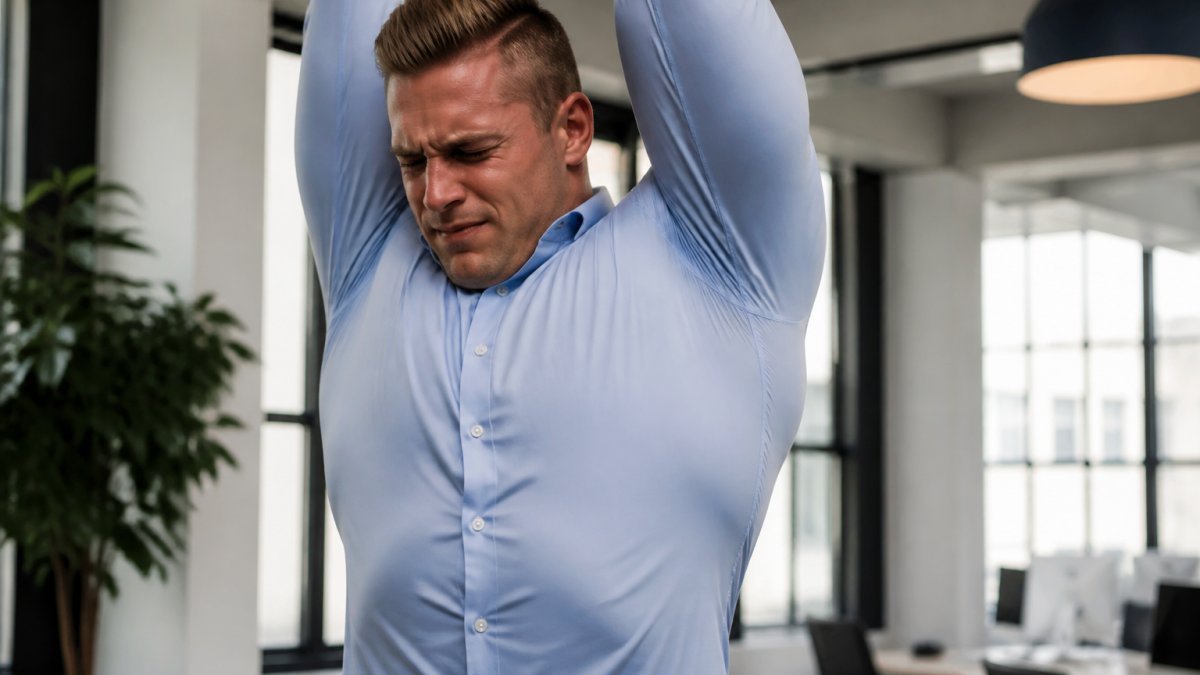
When fabric pulls tight across your shoulders, your nervous system recognizes the constraint. Your brain responds by limiting range of motion to avoid further restriction.
These compensations might seem small, but they accumulate across hundreds of reps. Over weeks and months, you've reinforced a suboptimal movement pattern. Your muscles don't develop through their full range.
Chest and shoulder tightness during pressing movements
During bench press, incline press, or overhead press, your chest and shoulders need full freedom to extend and retract. Restrictive clothing limits this extension.
When your shirt pulls tight across the chest, you can't achieve full scapular retraction. Your shoulders can't move back far enough.
The shoulder joint suffers most. As you press overhead, the shirt's armhole digs in. Your shoulder can't track in its natural path.
Over time, this altered pattern can lead to shoulder impingement or other issues. Your body's trying to move one way, but your clothing is forcing it another way.
Restriction across the back during pulling exercises
During rows, pull-ups, or lat pulldowns, your back muscles need to fully contract and extend. This requires significant scapular movement and shoulder blade retraction.
A tight dress shirt prevents full scapular retraction. As you pull, the fabric across your back resists the movement. Your shoulder blades can't move as far back as they should. You're not getting the full contraction your back muscles need.
Pulling exercises suffer more from tight clothing than pressing exercises because the back requires more space to move. A shirt that merely feels snug during pressing becomes genuinely restrictive during rowing movements.
Shirts for Muscular Arms: Why Standard Sleeves Don't Fit
Sleeve fit is where most off-the-rack dress shirts fail muscular builds completely.
Standard dress shirt sleeves are cut for arms with average bicep circumference. For serious lifters, that's often undersized.
A sleeve that's too narrow doesn't just feel tight. It restricts blood flow slightly, which is uncomfortable during wear.
The taper makes it worse. A sleeve that's already tight at the bicep gets narrower toward the wrist.
Real solutions require sleeves cut wider at the bicep and tapered less aggressively. This gives your arm room to move without the fabric sagging at the wrist.
| Sleeve Issue | Effect on Movement | Typical Fix |
|---|---|---|
| Narrow bicep circumference | Restricts arm bending and raising | Wider sleeve cut at upper arm |
| Aggressive taper | Creates friction and bunching | Gentler taper or straight cut |
| High armhole placement | Limits shoulder extension | Lower, wider armhole |
| Tight upper arm seam | Prevents full range overhead | Seam moved outward on shoulder |
Fabric Breathability and Heat Management in Restrictive Fits
When clothing fits too tightly, breathability becomes a secondary problem layered on top of movement restriction.
Tight fabric traps heat against your skin. Even breathable materials struggle when they're pulled snug.
During exercise or extended wear, this becomes noticeable. You overheat faster. Your body compensates by sweating more.
This is why oversized dress shirts feel cooler than properly fitted ones; the loose fabric allows air circulation.
Hyper Stretch Shirt In Pure White →
The solution is fabric that breathes AND clothing cut wide enough to allow air movement without looking baggy. This requires both fabric choice and pattern design working together.
Stretch Dress Shirts for Men: A Better Alternative
Stretch fabrics solve part of the problem but not all of it.
A dress shirt made with elastane (spandex) stretches when you move. This gives you more freedom than a rigid woven fabric.
But stretch fabric doesn't fix poor armhole placement or sleeve taper. A sleeve that's cut too narrow still restricts you, even if it stretches.
Stretch is necessary for muscular builds, but it's not sufficient by itself.
This is where muscle-fit design becomes essential. Brands like Fitizen engineer their patterns specifically for athletic proportions. The armholes are deeper and positioned further back.
Add stretch fabric to a properly engineered pattern, and you get genuine freedom of movement. The Hyper Stretch Shirt In Pure White and Hyper Stretch Shirt In Jet Black combine muscle-fit construction with hyper-stretch fabric.


How Should a Dress Shirt Fit for Full Range of Motion
Proper fit for muscular builds requires thinking differently about what "fit" means.
A dress shirt shouldn't be tight anywhere. It should be snug enough to look tailored, but loose enough to move freely. There's a specific window where a shirt looks sharp and functions well.
Armhole positioning and shoulder mobility
Your armhole should sit at the edge of your shoulder, not higher.
Test this: raise your arm overhead slowly. You should feel no restriction at the shoulder. The fabric should move with your arm, not pull or dig in.
For full overhead mobility, you need a sufficiently deep armhole. Many muscular individuals need a deeper fit than standard dress shirts provide. This is significantly deeper than standard dress shirts.
The armhole width also matters. It should be wide enough that your shoulder blade has room to move. A narrow armhole restricts scapular movement, which limits your overhead range.
Sleeve length and upper arm freedom
Your sleeve should reach your wrist bone when your arm hangs naturally. Standard sleeve length is fine if the sleeve itself is cut properly.
The upper arm section is critical. Your bicep should have adequate clearance in all directions.
Test this: bend your arm to 90 degrees. The sleeve should move with your arm smoothly. If you feel bunching or pulling, the sleeve is cut too narrow.
The sleeve taper should be gentle. From bicep to wrist, the circumference should decrease gradually, not sharply. A sharp taper creates that compression feeling that interferes with movement.
Chest and waist proportions without movement restriction
Your shirt should fit your chest without pulling across the back. This is where most standard shirts fail muscular builds.
Button the shirt and move your arms in circles. You should feel no resistance. If the shirt pulls across your back or shoulders, it's too tight.
The waist should be tapered enough to look sharp, but not so much that it restricts your core. You should be able to bend forward fully without the shirt pulling up or restricting your torso.
Movement-by-Movement Fit Tests for Bodybuilders
Before buying any dress shirt, test how it moves through actual exercises.
Testing overhead pressing mobility
Raise your arm straight overhead as if doing an overhead press. The shirt should move freely. You should feel no pulling at the shoulder or chest.
If you feel the armhole digging in or the chest pulling tight, the shirt won't work for you. This is the most restrictive movement for dress shirts, so it's your best test.
Testing lateral raise freedom
Raise your arm out to the side to shoulder height, then higher. The sleeve should move with your arm. You should feel no restriction in the upper arm or shoulder.
If the sleeve pulls tight around your bicep or the armhole digs in, the shirt is too narrow. This test reveals sleeve taper problems that the overhead test might miss.
Testing torso rotation and pulling movements
Rotate your torso side to side. The shirt should move with you. Cross your arms in front of your chest as if doing a rowing movement. The back should have plenty of room.
These movements test whether the back has enough space for scapular movement. If the shirt pulls tight across your back during these movements, it will restrict your pulling exercises.
Finding clothing that fits muscular builds requires understanding why standard dress shirts restrict movement. Hyper-stretch fabrics combined with proper armhole depth, sleeve width, and chest proportions give you the freedom to move fully while maintaining a sharp, tailored look. View our muscle-fit collection and experience clothing designed specifically for how you're built.
Frequently Asked Questions
Why do dress shirts feel tight across the shoulders and chest?
Traditional dress shirts are cut with narrow armholes and shoulder seams positioned too far back. When you have muscular shoulders and chest, the fixed pattern doesn't account for your larger frame. The fabric sits too close to your body, and the seam placement pulls inward, creating friction and restricting mobility. This happens regardless of the fabric's stretch properties because the construction itself is the limiting factor.
Can stretch fabric make a dress shirt more comfortable for bodybuilders?
Yes, but only partially. Elastane-blend fabrics add freedom of movement by allowing the garment to move with your body rather than against it. However, stretch fabric alone cannot fix poor armhole depth or shoulder seam placement. The best solution combines stretch fabric with a pattern designed for muscular builds, such as tapered muscle-fit cuts that accommodate larger arms without excess waist fabric.
How should a dress shirt fit for someone with muscular arms?
The sleeve should sit comfortably around your bicep and tricep without pulling or bunching, with the armhole positioned higher to allow full range of motion in your shoulder. The chest and shoulder seams should align with your actual shoulder width, not pull inward. A tapered waist prevents bagginess while the upper body remains spacious. Test the fit by raising your arms overhead and performing lateral raises, you should have complete freedom without feeling restricted.
What's the difference between traditional dress shirts and muscle-fit alternatives?
Traditional dress shirts use a straight cut from chest to waist with narrow armholes and set-back shoulder seams, designed for average builds. Muscle-fit shirts feature deeper armholes, higher shoulder seams aligned with athletic frames, tapered waists, and often stretch fabrics like elastane blends. This combination accommodates larger shoulders, chest, and arms while maintaining a tailored silhouette. The Hyper Stretch Shirt in Pure White, for example, combines hyper-stretch fabric with a tapered muscle-fit cut specifically for athletes.