

Table of Contents
- Why Standard Jeans Fail When You Have Big Thighs
- How to Measure Thighs for Jeans: The Only 3 Numbers That Matter
- The 5-Point Fit Check for Athletic Fit Jeans for Men
- Why Stretch Denim for Men Is Non-Negotiable
- Fit Troubleshooting: Fixing the Waist Gap and Other Common Issues
- Styling: Balancing Proportions from Gym to Street
- Conclusion: Your Next Step to a Better Fit
- Frequently Asked Questions
Last Updated: September 5, 2026
Why Standard Jeans Fail When You Have Big Thighs
You know the drill. You find a pair that fits your waist, pull them up, and then the real test begins. The fabric strains across your quads, the crotch sits too high, and the moment you sit down, it feels like the seams might give out.
Finding jeans for men with big thighs is frustrating because off-the-rack denim is cut for a straight, narrow silhouette. Most brands assume a waist-to-thigh ratio that simply doesn't exist for anyone who squats, deadlifts, or cycles. When you size up to fit your legs, you get a massive gap at the back of the waistband.
This guide from Fitizen breaks down exactly what to measure, which features actually matter, and how to find a pair that fits your physique without looking like you borrowed your dad's trousers.
The core issue is that standard jeans are constructed from rigid, heavyweight denim with no give. A fabric that doesn't stretch has to fit perfectly across every point simultaneously. Your waist and thighs rarely share the same proportions as the average man, so the garment fails at one end or the other. The result is either restricted movement or a sloppy, baggy look.
How to Measure Thighs for Jeans: The Only 3 Numbers That Matter
Before you buy anything, you need three measurements. Grab a soft tape measure and follow these steps.
1. Thigh circumference. Stand with your feet shoulder-width apart. Measure around the widest part of your thigh, usually about 5-7 cm below your crotch (the CDC). Keep the tape snug but not tight. This number tells you the minimum leg opening you need through the upper leg.
2. Waist measurement. Measure around your natural waistline, where your jeans will actually sit. Do not suck in your stomach. This is the number that causes the dreaded waist gap when it doesn't match your thigh size.
3. Rise height. Measure from the crotch seam up to the top of the waistband, both front and back. A higher rise sits below the belly and accommodates larger glutes without digging in.
The relationship between your waist and thigh measurements determines everything. If your thigh measurement is more than about 1.8 times your waist measurement, standard cuts will not work (peer-reviewed research). You need a cut designed for a muscular build.
The 5-Point Fit Check for Athletic Fit Jeans for Men
Athletic fit jeans for men are cut with a wider thigh and a tapered leg, giving you room where you need it while still looking sharp. But not all athletic cuts are created equal. Run through this five-point check before you commit.
1. The waist test. You should be able to slide two fingers between your waist and the waistband. If you need a belt to keep them up, the jeans are too big, and you will get bunching fabric.
2. The thigh test. Bend your knee to a 90-degree angle. The fabric should feel snug but not restrictive. If you see strain lines across the quad, the cut is too narrow.
3. The crotch check. The crotch seam should sit against your body, not hang low or pull up. A gusseted crotch adds extra fabric for movement and prevents the seam from ripping during deep squats.
4. The seat test. Squat down fully. The jeans should not pull down at the back or gap at the waist. This is where most standard fits fail.
5. The leg opening. With a tapered leg, the opening should skim your calf without flapping. If you have big calves too, look for a slight taper rather than an aggressive one.
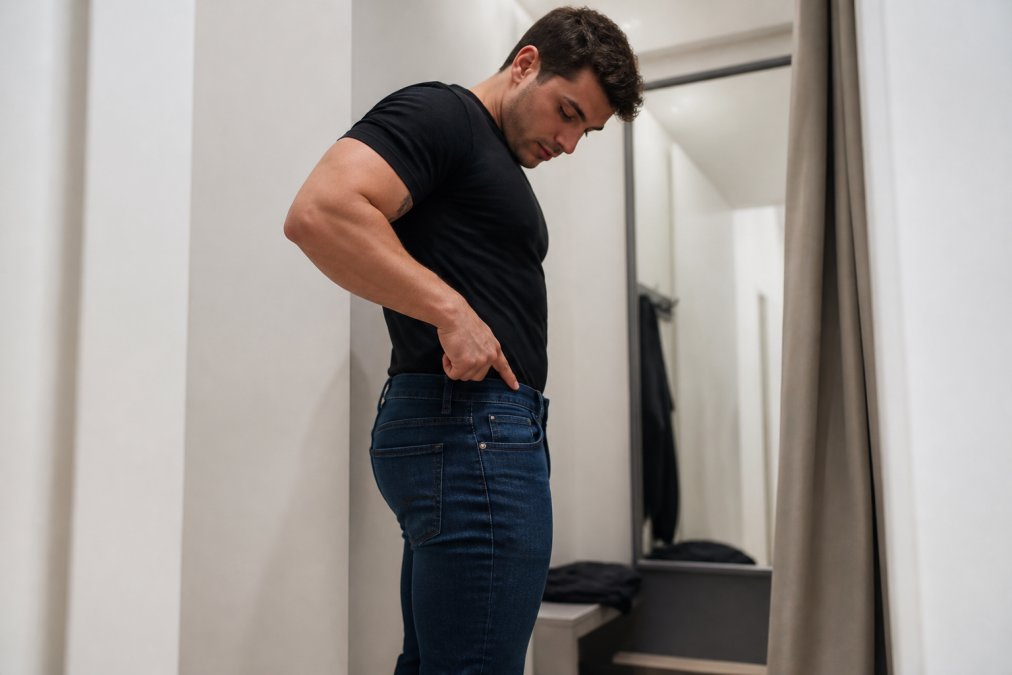
Why Stretch Denim for Men Is Non-Negotiable
Stretch denim for men is the single biggest innovation in casual trousers for athletic builds. The elastane or spandex blend allows the fabric to flex with your muscles instead of fighting them.
A common mistake is assuming all stretch denim feels like gym wear. Quality stretch denim uses a cotton base with a small percentage of elastane, typically 2-4%, which provides comfort without sacrificing the look of real denim (peer-reviewed research). The fabric should recover its shape after stretching, not sag permanently at the knees and seat.
The difference comes down to fabric weight and recovery. Lightweight denim under 10 oz feels soft but wears out quickly. Mid-weight denim between 10-14 oz offers the best balance of durability and comfort for daily wear. Heavyweight denim above 14 oz looks great but needs a higher elastane content to remain wearable.
Fabric Weight and Recovery: What to Look For
When you're checking the label, look specifically for the elastane percentage and the fabric weight. A pair that combines 12-13 oz denim with around 3% elastane gives you the structure of traditional jeans with the mobility you need.
Denim recovery is how well the fabric returns to its original shape after being stretched. Poor recovery means baggy knees by lunchtime. High-quality stretch denim uses a core-spun yarn where the elastane is wrapped in cotton, which improves durability and recovery compared to cheaper blends.
The waistband is where recovery matters most. A waistband that stretches out will cause the jeans to slide down, creating the exact waist gap you're trying to avoid. Look for a reinforced waistband or a higher rise that sits below the belly and stays put.
Fit Troubleshooting: Fixing the Waist Gap and Other Common Issues
The waist gap is the most common complaint from lifters, and it happens when the jeans fit your thighs but the waistband is too wide. You have three options to fix it.
First, look for jeans with a higher rise. A mid-rise or high-rise cut sits closer to your natural waist, which reduces the gap because the waistband curves with your body rather than cutting straight across. Standard low-rise jeans sit below the waist, which creates a gap when you have muscular glutes.
Second, consider taking the waist in with a tailor. A good tailor can take in the waistband by 2-4 cm while leaving the thighs untouched. This is a cheap fix that transforms a good-enough pair into a great one.
Third, buy jeans with a stretch waistband. Some athletic-fit jeans incorporate elastane into the waistband itself, which allows it to flex with your movements while maintaining a snug fit. This is a feature worth seeking out if the waist gap is a recurring problem for you.
Other common issues include jeans that are too tight in the calf, which restricts movement when you walk, and jeans that bunch at the ankle, which ruins the silhouette. A tapered leg with a slightly wider opening at the bottom solves both.
Styling: Balancing Proportions from Gym to Street
The goal with jeans for men with big thighs is a silhouette that balances your upper and lower body. If your legs are the focal point, you need to dress to complement them, not hide them.
Pair with a fitted top. A slim-fit t-shirt or polo balances your proportions by showing your upper body matches your lower body. An oversized top makes your legs look even bigger and creates a sloppy silhouette.
Choose the right wash. Darker washes like indigo or black are more versatile and create a slimming effect. They transition easily from casual to smart-casual settings. Lighter washes work for weekends and casual wear but read as less polished.
Tapered is your friend. A tapered leg that narrows from the knee to the ankle creates a clean line that doesn't flare out at the bottom. It also prevents the fabric from catching on your shoes or bunching around your ankles.
Match your footwear. The leg opening should complement your shoes. A smaller leg opening works with trainers and loafers, while a wider opening suits boots. If you wear both, aim for a middle ground that works with everything.
Consider the occasion. For the office, pair dark-wash jeans with a button-down shirt and leather shoes. For the gym or weekends, a relaxed t-shirt and trainers work fine. The right pair of athletic-fit jeans should handle both without looking out of place.
Conclusion: Your Next Step to a Better Fit
Finding jeans that fit your thighs without sagging at the waist is not about settling for less. It's about knowing your measurements and understanding which features matter. Focus on the three key numbers, look for stretch denim with good recovery, and don't accept a poor fit as inevitable.
At Fitizen, we design muscle-fit clothing specifically for athletes and lifters, with hyper-stretch fabrics that move with you and a tailored cut that highlights your physique rather than hiding it. Our jeans are built to eliminate the baggy fits and restrictive materials you've been putting up with.
Stop compromising on fit. Get started with Fitizen and find jeans that actually fit your build.
Frequently Asked Questions
What type of jeans should I wear if I have thick thighs?
You need jeans with a specific cut: an athletic fit or a tapered fit. These cuts offer extra room in the thigh and seat while tapering down to the ankle to avoid a baggy look. Look for a pair with a higher rise to help prevent the waistband from gaping. Crucially, choose a pair with stretch denim, usually containing elastane or spandex. This gives the fabric the flexibility to move with you and recover its shape.
How should jeans fit around the thigh area?
The thigh should fit snugly but not tightly. You should be able to pinch about 2-3 cm of fabric, and you must be able to comfortably insert your hand into the leg opening when standing. There should be no pulling or strain across the fabric when you walk or sit. If you can't pinch any fabric, they are too tight. If you can grab more than 3 cm, they are too loose and will look baggy.
How do I measure my thigh for jeans?
To measure your thigh correctly, stand with your feet shoulder-width apart. Find the widest point of your upper thigh, which is usually about 5 cm below your crotch. Wrap a measuring tape around this point, keeping it horizontal and snug against your skin, but not digging in. Note this circumference in centimetres and compare it to the brand's size guide to ensure the cut provides enough room for you to move comfortably.
Why do my jeans always end up baggy after a few washes?
This is usually a sign of low-quality stretch fabric with poor recovery. Cheaper denim often uses a higher percentage of elastane with a looser weave, which loses its tension quickly. Look for denim that specifies a higher fabric weight (12 oz or more) and a tight weave. A quality pair should spring back to its original shape after washing, so always check the care label and avoid tumble drying to extend the life of the stretch.