

Table of Contents
- Why Standard Professional Clothing Fails Muscular Builds
- Muscle Fit Dress Shirts for Men: Cut for Broad Shoulders and V-Taper
- Hyper Stretch Fabrics and Performance Features in Professional Clothing
- Tailoring Tips for Bodybuilders: Adjustments That Work With Your Physique
- Building a Capsule Wardrobe for Athletes: Key Pieces and Smart Pairings
- Professional Clothing for Bodybuilders 2026: Trends and Muscle-Fit vs Oversized
- Conclusion
- Frequently Asked Questions
Last Updated: September 16, 2026
Why Standard Professional Clothing Fails Muscular Builds
Off-the-rack professional clothing is cut for average proportions, so a lifter with a broad chest and a narrow waist ends up choosing between a jacket that strangles the shoulders and trousers that balloon at the waist. This guide from Fitizen explains how to dress a trained physique properly in 2026.
Three failure points show up again and again:
- Shoulder and armhole restriction. A standard armhole sits too low and too far inboard, so raising your arms drags the whole shirt up.
- Waist and seat excess. Trousers cut for a straight torso hang loose at the waist and seat, and the fabric bunches over the glutes.
- Quad and thigh strain. Slim-leg trousers that fit the waist often won't clear developed quads, and the seam stress shows within weeks.
Muscle Fit Dress Shirts for Men: Cut for Broad Shoulders and V-Taper
A muscle fit dress shirt for men is cut with a higher armhole, a broader shoulder and chest, and a tapered waist, so the fabric follows your V-taper instead of fighting it. That combination separates a shirt that flatters a trained physique from one that just looks tight.
- Armhole height. Raise both arms overhead. If the shirt hem lifts more than a couple of centimetres, the armhole is too low.
- Shoulder seam position. The seam should sit on the edge of the shoulder, not halfway down the upper arm.
- Chest and waist ratio. Look for a stated drop between chest and waist, or a tapered cut, rather than a straight box.
- Fabric recovery. Grip the fabric, release it, and watch whether it springs back or stays stretched.
Hyper Stretch Fabrics and Performance Features in Professional Clothing
Four technical features matter most in performance professional clothing:
- Four-way stretch. Stretch on both the warp and weft, so the fabric moves with rotation and lateral movement, not just bending.
- Moisture-wicking and breathability. Pulls sweat away from the skin and lets it evaporate, which matters when you're moving between a warm commute and a cooled office.
- Anti-odour treatment. Reduces the build-up of odour-causing bacteria in the fabric, useful when the same trousers go from a morning session to a client meeting.
- Thermal regulation. Keeps you comfortable across temperature swings without adding bulk.
Fabric weight matters too. Heavier knits drape better and hide the contours of a fitted cut, while very light fabrics cling and show every seam line. For trousers, choose enough weight to hang cleanly; for shirts, a mid-weight stretch weave balances structure and movement.
Tailoring Tips for Bodybuilders: Adjustments That Work With Your Physique
Tailoring tips for bodybuilders come down to adjusting the garment to your proportions rather than shrinking it to a standard block. A good tailor works with the drop you already have instead of trying to eliminate it.
The adjustments that actually deliver results:
- Take in the waist and seat, never the chest. Suppressing the waist creates the V-taper; narrowing the chest just makes the shirt pull.
- Raise the armhole if the pattern allows. This is the single highest-impact alteration for broad shoulders, though it's skilled work and not every tailor will attempt it.
- Shorten sleeves from the shoulder, not the cuff. Shoulder-shortening preserves the taper and keeps the cuff detail intact.
- Taper the leg from the knee down. This clears your quads through the thigh while keeping a clean line at the ankle.
- Let out the seat before tapering the waist. If the trousers pull across the glutes, the seat needs room, not a tighter waist.
Building a Capsule Wardrobe for Athletes: Key Pieces and Smart Pairings
A capsule wardrobe for athletes is a small set of garments chosen for fit, stretch, and versatility, so every piece works for training, travel, and the office without a separate gym-to-street change. For a bodybuilder, a capsule has a second job: it has to survive a physique that changes size two or three times a year. Maintaining this level of adaptability requires a precise understanding of your current proportions, which begins by measuring your body to ensure each garment accommodates your shifting muscle mass throughout the off-season and prep.
The six-piece core
| Piece | Why it earns its place | Fitizen option |
|---|---|---|
| Muscle-fit shirt | Works under a jacket or on its own | Hyper Stretch Shirt, £69.00 |
| Athletic-fit chinos | Smart enough for meetings, comfortable all day | Hyper Stretch Chinos, £89.00 |
| Hyper-stretch jeans | Handles casual days and travel | Hyper Stretch Jeans, £89.00 |
| Cargo trousers | Practical pockets without a baggy cut | Cargo Trousers, £89.00 |
| Muscle-fit hoodie | Layers over a shirt, sharp enough for casual Fridays | Muscle Fit Hoodie, £67.00 |
| Structured jacket | Adds formality to any of the above | Pair with the shirt and chinos |
The logic is simple: if every trouser shares the same athletic block and every shirt the same tapered cut, any top pairs with any bottom and the proportions hold.

Sizing for the bulk, tailoring for the cut
A common pattern among lifters is to buy for the largest size you expect to reach in a training year, then have the waist and seat taken in as you lean out. Four-way stretch fabrics tolerate the reverse direction, a shirt bought at peak bulk still sits cleanly at the end of a cut because the recovery pulls the fabric back to shape.
Hyper Stretch Jeans In Stay Black →
Practical rules that work across a training year:
- Buy shirts to fit the chest and shoulders at your bulked size. Waist suppression is a cheap alteration; chest and shoulder reconstruction is not.
- Buy trousers to fit the quads and seat. The waist can be taken in by 4 to 6 cm without distorting the leg line; the thigh cannot be let out.
- Keep one 'cut-phase' pair of trousers in a size down. Trying to tailor a bulked pair down by more than one size rarely looks right at the knee.
- Prioritise garments with generous seam allowance. A tailor can only work with the fabric that is there.
The care routine that keeps the capsule alive
High-sweat training gear loses its stretch and odour resistance faster than office clothing. Two habits make the biggest difference:
- Wash cool, never hot. Heat degrades elastane and accelerates the loss of four-way recovery. A 30°C cycle preserves stretch far longer than a 40°C or 60°C wash.
- Skip fabric softener. It coats the fibres and blocks moisture-wicking and anti-odour finishes, so the garment stops doing the job you paid for.
- Air-dry where possible. Tumble drying is the single fastest way to kill recovery in a stretch fabric.
Professional Clothing for Bodybuilders 2026: Trends and Muscle-Fit vs Oversized
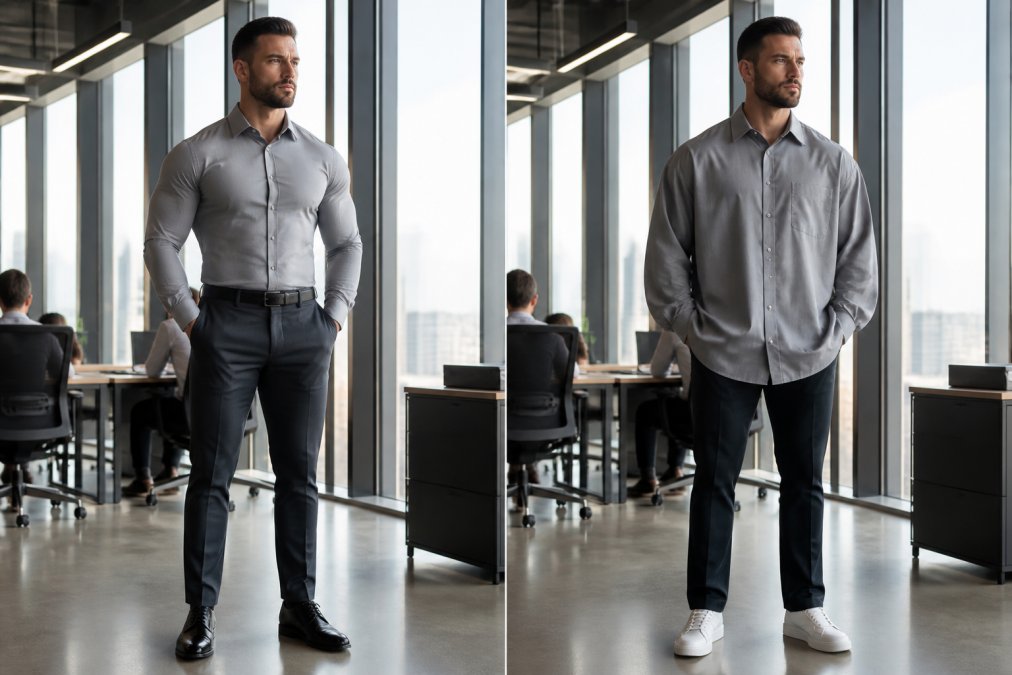
The 2026 shift: technical tailoring, not gym-wear-as-workwear
The bigger shift is technical. Performance fabrics have moved from the gym into tailoring, so "professional" no longer means stiff and restrictive: garments now offer four-way stretch in cuts that pass for business casual. The line between training gear and workwear has blurred, and the smartest wardrobes sit right on it.
Three specific directions are worth watching this year:
- Stretch wovens replacing stretch knits in tailoring. Wovens hold a sharper line at the shoulder and lapel while still giving four-way movement, which is why muscle-fit shirts are moving away from jersey and toward high-recovery woven blends.
- Weighted drape over cling. Mid-weight fabrics that hang cleanly are winning over very light stretch fabrics that show every seam line under office lighting.
- Colour discipline. Grey melange, graphite, and stay-black are dominating because they read as professional across a wider range of settings than the bright training colours that were common a few years ago.
The angle no one else covers: sustainable stretch
Most articles on this topic focus on aesthetics and fit and ignore the environmental cost of synthetic gym fabrics. That matters more in 2026 because elastane and polyester blends are notoriously hard to recycle; they are difficult to separate back into their component fibres at end of life.
- Buy fewer, better pieces. A capsule of six garments that lasts three years has a far lower footprint than twelve fast-fashion pieces replaced annually, and it fits the capsule logic above.
- Favour garments designed for repair and alteration. A shirt with generous seam allowance can be taken in and let out as your body changes, which extends its working life instead of forcing a replacement.
- Treat durability as a sustainability metric. A fabric that holds its recovery after 50 washes is, in practice, a greener choice than one that bags out after ten, regardless of what the label claims.
- Check care instructions before buying. Cool-wash, air-dry garments use less energy over their lifetime, and they also happen to be the ones that keep their stretch longest.
Conclusion
The hardest part of dressing a trained physique isn't finding clothes, it's finding clothes cut for the body you've actually built rather than the average one the high street assumes. Getting the block right solves most of the problem before you visit a tailor.
Frequently Asked Questions
What are the best fabrics for professional clothing for muscular builds?
Fabrics with high stretch and recovery, such as hyper stretch denim or blends with elastane, work best. They move with you without losing shape. Avoid stiff, non-stretch cotton that restricts movement. Fitizen uses hyper stretch fabrics in their jeans, chinos, and shirts, designed for athletic bodies.
How do I find professional shirts that fit broad shoulders without looking baggy?
Look for muscle fit or athletic fit shirts that are tapered through the waist. Brands like Fitizen offer muscle fit dress shirts for men that accommodate broad shoulders and a V-taper. Check size guides for chest and waist measurements. If in doubt, size up and have the waist taken in by a tailor.
Should bodybuilders opt for bespoke tailoring or muscle-fit brands?
It depends on your budget and needs. Bespoke tailoring offers a perfect fit but costs more and takes time. Muscle-fit brands like Fitizen provide off-the-rack options that fit muscular proportions well, with hyper stretch fabrics for comfort. Many bodybuilders use both: muscle-fit for everyday and bespoke for special occasions.
How can I maintain a professional appearance while accommodating muscle growth?
Choose fabrics with hyper-stretch. Build a capsule wardrobe for athletes with versatile pieces that mix and match. Regularly review your fit as your body changes; a tailor can adjust existing garments. Prioritise comfort and range of motion without sacrificing a sharp look.